
If you are a Florida homeowner researching pool or patio contractors, Pool And Patio Reviews is built specifically for you. The site aggregates verified customer reviews from Google Business Profile, Yelp, Angi, Houzz, and BBB complaint records, organizes them by Florida region and service category, and lets you compare contractors side by side before you pick up the phone. This guide walks you through how the platform works, what real reviewers say about Florida contractors, what to expect on costs and timelines, and how to use the site's tools to protect yourself from fake reviews and unlicensed operators.
Florida Pool Patio Reviews: Verified Contractor Insights

Maren Lawson
10 Aug 2026
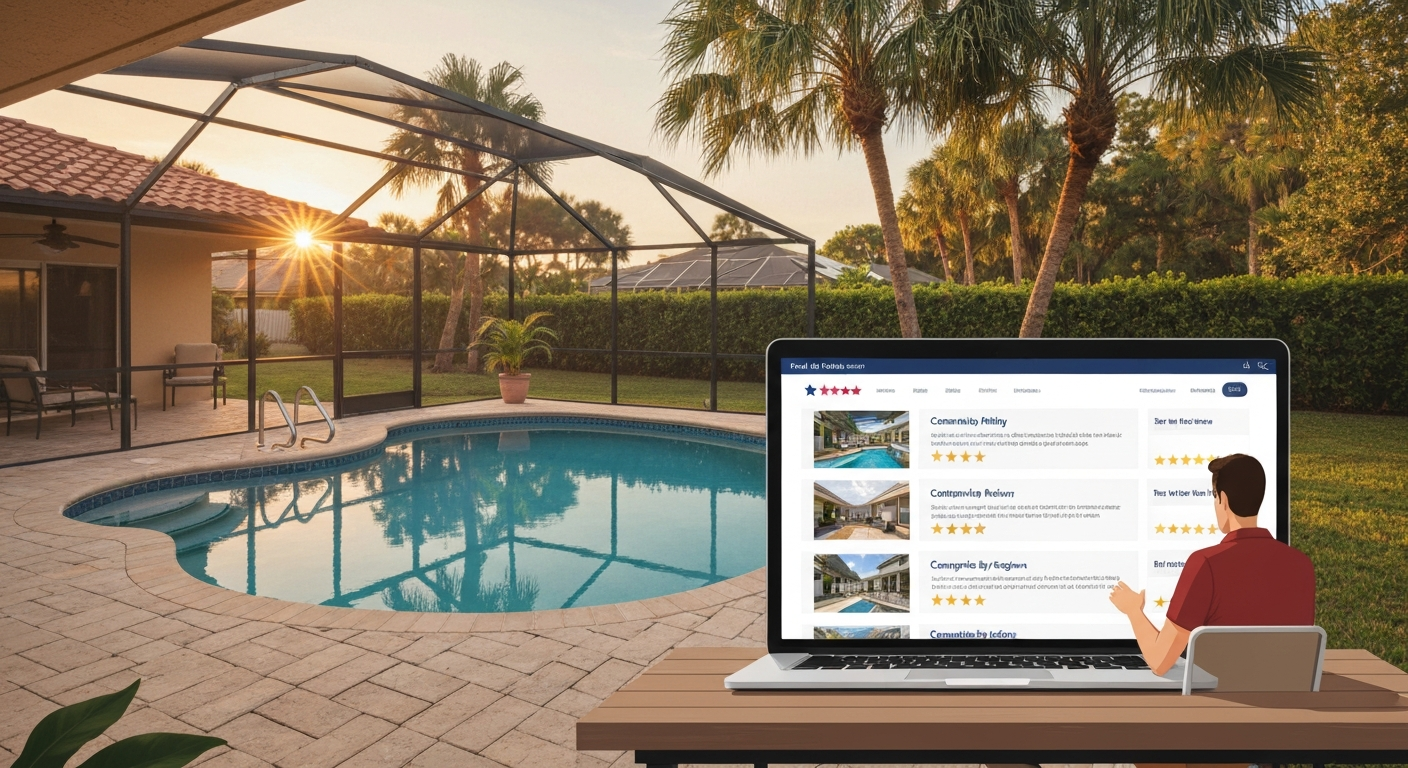
Who this guide is for and what to expect
This article is written for Florida homeowners who are at or near the point of hiring a contractor for a pool build, patio enclosure, custom deck, sunroom, or outdoor kitchen. You may have already collected a few names from neighbors or done a quick Google search. What you probably have not done yet is read through enough verified reviews to know which complaints are one-offs and which represent a real pattern. That is exactly what Pool And Patio Reviews is designed to help with. The site does not sell leads and does not accept paid placements from contractors, which means the ratings and review summaries you see reflect what customers actually reported, not what a contractor paid to show you.
The platform covers contractors across the full Florida peninsula, from Pensacola and Jacksonville in the north down through Tampa Bay, Orlando, and the Space Coast to South Florida's Miami-Dade, Broward, and Palm Beach counties. Specific company review pages are available for commonly searched brands, including Legacy Pools and Patio, Metro Pools and Patios, and Tiger Pool and Patio. If you have landed here after searching for something like 'patio pools Tucson reviews,' that query covers an Arizona-based company and is covered separately on this site since Florida and Arizona contractors operate under different licensing frameworks and regional conditions.
How Pool And Patio Reviews verifies and organizes Florida contractor reviews
The site pulls reviews from multiple public sources and applies a structured cross-referencing process before any contractor profile goes live. The primary sources are Google Business Profile reviews (which surface in Search and Maps and are tied to Google's own verification and anti-manipulation policies), Yelp (filtered through Yelp's content guidelines and its algorithmic 'not recommended' layer), Angi and HomeAdvisor profiles, and Houzz project galleries with attached reviews. For details on Google's verification process and rules for Business Profiles, see Verify your business on Google, Google Business Profile Help blank" rel="noopener noreferrer">Verify your business on Google — Google Business Profile Help. Houzz is particularly useful for visually design-heavy work like sunrooms, patio enclosures, and custom decks because it shows before-and-after project photos alongside the written review, giving you context that a star rating alone cannot provide. Industry and trade associations such as the Pool & Hot Tub Alliance (PHTA) provide member directories, technical standards, certification programs, and paid market reports that are often used as authoritative industry benchmarks blank" rel="noopener noreferrer">Pool & Hot Tub Alliance (PHTA) — trade association (membership, standards, market reports).
On top of raw review aggregation, each Florida contractor profile is cross-checked against the Florida Department of Business and Professional Regulation's public license lookup (MyFloridaLicense). Florida Statutes Chapter 489 governs who is legally required to hold a Certified or Registered Contractor license for pool construction, screen enclosures, and other outdoor-living work, so a contractor without a verifiable Chapter 489 license is flagged immediately on their profile. The site also checks BBB complaint histories and resolution records, Florida Attorney General consumer complaint filings, and county civil court records (clerk portals for Miami-Dade, Hillsborough, Orange, Duval, Palm Beach, and Lee counties) to surface unresolved disputes or mechanic's lien filings that reviewers may not have mentioned explicitly.
Review freshness matters too. A contractor who had complaints four years ago but has consistent five-star reviews from the past 12 months tells a different story than one whose rating has been sliding. The site timestamps every review batch and flags profiles where recent negative reviews represent a meaningful shift from historical averages.
Regional coverage and how to search by city, county, or neighborhood
Florida's contractor market is genuinely fragmented. A screened enclosure company that dominates Sarasota may have zero presence in Jacksonville, and the permitting environment in Miami-Dade is meaningfully different from Pinellas County. To reflect that, the site organizes contractors using the same Metropolitan Statistical Area (MSA) boundaries defined by the U.S. Census Bureau and the Office of Management and Budget. Those federal definitions give the site a consistent, non-arbitrary way to group contractors by region rather than relying on self-reported service areas that contractors often overstate. Region boundaries are based on the Metropolitan and Micropolitan Delineation Files, U.S. Census Bureau, which implement the Office of Management and Budget's metropolitan and micropolitan statistical area definitions Metropolitan and Micropolitan Delineation Files — U.S. Census Bureau.
The major Florida regional groupings on the site align with the following MSAs and their core counties, and you can search within any of them directly from the homepage.
| Region | Core Counties | Major Cities Covered |
|---|---|---|
| South Florida | Miami-Dade, Broward, Palm Beach | Miami, Fort Lauderdale, Boca Raton, West Palm Beach |
| Tampa Bay | Hillsborough, Pinellas, Pasco | Tampa, St. Petersburg, Clearwater, New Port Richey |
| Orlando / Central Florida | Orange, Osceola, Seminole, Lake | Orlando, Kissimmee, Sanford, Lakeland |
| Jacksonville / Northeast FL | Duval, St. Johns, Clay, Nassau | Jacksonville, St. Augustine, Fleming Island |
| Southwest Florida | Lee, Collier, Charlotte | Fort Myers, Naples, Cape Coral, Port Charlotte |
| Space Coast / Treasure Coast | Brevard, Indian River, Martin, St. Lucie | Melbourne, Vero Beach, Port St. Lucie |
| Panhandle / Northwest FL | Escambia, Santa Rosa, Okaloosa, Bay | Pensacola, Destin, Panama City |
Within each regional group, you can filter further by city or ZIP code. For neighborhood-level searches in dense metros like Miami or Tampa, the ZIP filter is the fastest path. If you want to stay within a specific county because you know permitting and inspection timelines vary (and they do, more on that below), the county filter will narrow results to contractors who have documented work in that jurisdiction. One practical tip: search your county first, then expand to the full MSA if you get fewer than five results. Five verified reviews is generally the minimum needed to see reliable patterns.
How to read ratings, use site filters, and report suspicious reviews
The aggregate star rating on each contractor profile is a weighted average that accounts for review recency and source diversity. A contractor with 80 Google reviews and zero reviews anywhere else gets a lower confidence score than one with 40 Google reviews, 15 Houzz reviews, and a clean BBB record, even if their star averages are identical. Look at the confidence score alongside the star rating. When you see a high confidence score, it means the rating is backed by cross-platform consistency. A low confidence score with a high star rating is a flag worth investigating.
The site offers several filters that go beyond star ratings. You can filter by service type (pool construction, pool remodel, patio enclosure, custom deck, sunroom, outdoor kitchen), by license status (active Chapter 489 license confirmed or unverified), by project size (small under $15,000, mid-range $15,000 to $75,000, large over $75,000), and by review recency (past 6 months, past year, all time). Sorting by 'most relevant' surfaces reviews that mention specific themes like timeline delays or warranty issues, which is more useful than sorting by date alone when you are trying to evaluate a contractor for a specific job type.
If you read a review that seems fake or retaliatory, use the 'Report Review' button on any review card. The editorial team reviews flagged submissions against the original platform source and the account history of the reviewer. Reviews flagged as potentially fake are quarantined from the aggregate score while under review. You can also submit your own verified review directly through the site after completing a project. Submission requires a job completion date, a county, and a service category. The team cross-references submitted reviews against permit records where available to confirm a project actually occurred in the stated location.
What Florida reviewers actually report: recurring themes
After going through hundreds of Florida pool and patio reviews aggregated on this site, certain themes come up so consistently that they are worth calling out before you even start reading individual contractor profiles. These are not generalizations, they are patterns confirmed across multiple platforms and regions.
Build quality and materials
Positive reviews from Florida homeowners disproportionately mention specific product upgrades (pebble finish interiors, travertine coping, variable-speed pumps) and credit the contractor for explaining the long-term value of those choices. Negative reviews almost always cite one of two failure modes: structural defects that appeared within the first year (cracking plaster, settling decks, screen frame gaps) or equipment issues tied to improper installation. The latter matters more than most homeowners realize because major equipment manufacturers like Hayward, Jandy, and Pentair require installation by a qualified contractor to preserve factory warranty coverage. Reviewers who later discovered their equipment warranty was voided because of how it was installed are consistently the angriest people in the review pool, and rightfully so.
Timelines and permit delays
Timeline complaints are the single most common negative theme in Florida outdoor reviews, and a significant portion of those complaints trace back to permitting rather than contractor negligence. Permit review timelines in Florida vary widely by county. Simple residential permits in some jurisdictions can move in five business days, while first-review cycles in Hillsborough and Duval counties have been reported at 10 to 30 business days for more complex projects. Miami-Dade adds its own layer of complexity with additional plan review steps. Reviewers who were warned about this in advance tend to rate the contractor higher even when delays occurred. Reviewers who were promised a specific start or finish date that relied on an optimistic permit assumption are far more likely to leave one and two star reviews.
Communication
Communication is the clearest differentiator between five-star and two-star reviews for Florida contractors of similar technical quality. The specific complaint is almost always the same: the contractor was responsive before the contract was signed and then became hard to reach during the project. Proactive weekly updates, even short ones, generate outsized positive mentions. If a contractor you are researching has a split rating profile where many reviews are either five stars or one star with very few in the middle, that is often a communication problem rather than a skill problem.
Costs and contract transparency
Reviewers who reported surprise costs are split roughly evenly between cases where the contractor added legitimate change orders (owner-requested upgrades, unforeseen site conditions) and cases where charges appeared that were not discussed in advance. The distinguishing factor is almost always whether the original contract was itemized or lump-sum. Itemized contracts give homeowners a line-item baseline to evaluate change orders against. Lump-sum contracts make it harder to dispute additions. This pattern shows up in reviews across all regions and all service categories.
Warranties and post-project support
Warranty-related reviews are most frequent in the six to eighteen month range after project completion, which is when minor defects typically surface. The positive reviews in this category praise contractors who responded quickly to warranty calls without argument. The negative ones describe contractors who became difficult to reach after the final payment was made or who disputed whether a defect fell under workmanship warranty versus manufacturer warranty. For equipment-related warranty issues, the resolution often hinges on whether the contractor provided the homeowner with serial numbers, installation dates, and proof-of-purchase documentation at project close, as required by manufacturers like Jandy and Pentair.
Service categories covered on Pool And Patio Reviews
The site covers six primary service categories for Florida contractors. Each has its own review filter and contractor directory so you are always comparing apples to apples. Here is a quick overview of what each category includes and what reviewers tend to focus on.
| Service Category | Typical Scope | Top Reviewer Focus Areas |
|---|---|---|
| In-Ground Pool Construction | New gunite, fiberglass, or vinyl-liner pool builds including excavation, plumbing, electrical, and finish | Timeline, finish quality, equipment brand, permit management |
| Pool Remodels & Resurfacing | Replastering, pebble finish, tile replacement, equipment upgrades, deck resurfacing | Match to existing materials, disruption time, post-job cleanup |
| Patio Enclosures & Screen Rooms | Aluminum-frame screen enclosures, panoramic screening, re-screening existing frames | Frame gauge, screen mesh quality, wind load compliance, fastener corrosion |
| Custom Decks | Composite, wood, or pavers around pool or standalone; includes pergolas and shade structures | Material durability in Florida heat/humidity, leveling, fastener rust |
| Sunrooms & Acrylic Enclosures | Four-season or Florida room additions, glass or acrylic panels, HVAC integration | Seal quality, condensation, energy efficiency, permit/inspection compliance |
| Outdoor Kitchens | Built-in grills, countertops, refrigeration, plumbing, lighting, and utility connections | Waterproofing, countertop material, gas line work quality, electrical inspection |
Realistic cost and timeline ranges by service category
One of the most valuable things you can do before contacting a contractor is calibrate your expectations based on what projects in your region and category actually cost and how long they actually take. The ranges below are derived from reviewer-reported figures aggregated on this site combined with widely cited industry benchmarks. They are starting points for your research, not guarantees, and your final quote will depend on your specific site conditions, material choices, and local labor costs.
| Service Category | Typical Cost Range (Florida) | Typical Timeline (Contract to Final Inspection) | Key Variables |
|---|---|---|---|
| In-Ground Pool (new) | $45,000 – $120,000+ | 12 – 24 weeks | Pool type (gunite vs. fiberglass), county permit timeline, site access, finish selection |
| Pool Remodel / Resurfacing | $8,000 – $30,000 | 2 – 6 weeks | Size, current surface condition, equipment upgrades included |
| Screen Enclosure (new) | $6,000 – $20,000 | 2 – 5 weeks | Size, screen type, frame gauge, wind-load zone requirements |
| Custom Deck (pavers or composite) | $10,000 – $40,000 | 2 – 8 weeks | Square footage, material, drainage requirements, permit complexity |
| Sunroom / Florida Room | $20,000 – $80,000 | 6 – 16 weeks | Foundation work, HVAC integration, glass vs. acrylic, permitting |
| Outdoor Kitchen | $8,000 – $35,000 | 3 – 8 weeks | Appliance brands, countertop material, gas/electrical scope, permits |
A few things to understand when interpreting these ranges. First, the lower end of each range assumes straightforward site conditions, standard materials, and a contractor with a clean permit history in your county. If your yard has drainage issues, setback complications, or HOA requirements, costs and timelines typically move toward the higher end. Second, permit timelines are a real wildcard in Florida. A pool project in a county with a 25-business-day first-review cycle can add six or more weeks to your total project duration before a single shovel goes into the ground. Third, reviewers consistently report that projects which came in under the timeline estimate involved contractors who had an established relationship with the local building department, meaning they submitted complete, accurate permit packages the first time.
Contractor review snapshots: patterns across Florida
Rather than singling out individual contractors with scores that change as new reviews come in, this section summarizes the review patterns that show up repeatedly across Florida's most-searched contractor categories. These patterns are useful as a frame of reference when you go read the individual company pages.
Legacy Pools and Patio
Legacy Pools and Patio is one of the most frequently searched contractor names on this site. Reviews for this company cluster around a few consistent themes: generally positive feedback on finish quality and design consultation, mixed feedback on project timelines particularly during high-demand seasons, and occasional warranty follow-up complaints. The company's detailed review page, which is linked from the Florida contractor directory, breaks reviews down by service type and region so you can see whether the pattern you care about (say, pool remodels versus new builds) holds in your specific metro area.
Metro Pools and Patios
Metro Pools and Patios generates a high volume of reviews, which makes their profile one of the more statistically reliable ones on the site. Reviewers frequently mention sales process transparency as a positive, specifically that estimates were itemized and that scope changes were communicated in writing. Communication mid-project and post-project warranty responsiveness are the areas where reviewer opinions diverge most. The Metro Pools and Patios review page includes a breakdown by project phase (pre-construction, construction, post-completion) that is worth reading in sequence.
Tiger Pool and Patio
Tiger Pool and Patio reviews show a strong pattern of positive feedback on workmanship, particularly for screen enclosures and pool cage work, which aligns with the service mix they are most frequently reviewed for. Negative reviews are proportionally fewer but tend to focus on scheduling coordination during busy periods. Their review page on this site includes reviewer-submitted project photos, which gives you a better sense of typical output quality than star ratings alone.
A note on Patio Pools Tucson
Searches for 'Patio Pools Tucson reviews' land on a separate review page because that company operates in Arizona, not Florida. Florida's Chapter 489 licensing requirements, hurricane wind-load standards for screen enclosures, and local permitting jurisdictions do not apply to Arizona contractors, so comparing them to Florida operators would not be meaningful or fair to either. If you are searching from Tucson or researching Arizona contractors specifically, the Patio Pools Tucson review page covers that company's regional context separately.
A practical hiring checklist before you sign anything
Reading reviews is step one. Before you sign a contract with any Florida pool or patio contractor, work through this checklist. It draws directly from the patterns in negative reviews where homeowners described specific things they wished they had verified upfront.
- Verify the contractor's license on the Florida DBPR MyFloridaLicense portal. Confirm the license is active, covers the specific work type (pool construction and servicing, or specialty structure contracting as defined under Florida Statutes Chapter 489), and has no open disciplinary actions.
- Ask for proof of general liability insurance and workers' compensation coverage. Chapter 489 requires evidence of workers' comp coverage for license issuance and renewal. Uninsured contractors create personal liability risk for homeowners.
- Request an itemized written estimate, not a lump-sum number. Itemization lets you evaluate change orders objectively if they arise later.
- Ask who pulls the permit. The contractor should pull the permit in their name. If they suggest you pull it as the owner-builder, that is a flag indicating potential licensing or insurance issues.
- Ask about permit timelines in your specific county and factor that into your project start expectations, especially if you are in Miami-Dade, Hillsborough, or Duval where review times can run 15 to 30 business days.
- Get references from projects completed in the past 12 months in your county, not just general references. Ask those references specifically about communication during the project and post-completion warranty calls.
- Confirm equipment brand and model in writing before signing. Ask the contractor to provide you with serial numbers, installation documentation, and manufacturer warranty registration at project completion. This is required to preserve warranty coverage under Hayward, Jandy, and Pentair terms.
- Check the BBB profile for complaint history and resolution outcomes. One complaint resolved promptly is different from three complaints closed without resolution.
- Search the county clerk's civil court portal (Miami-Dade, Hillsborough, Orange, Duval, or Palm Beach depending on your location) for mechanic's liens or contract disputes under the contractor's business name.
- Do not make a final payment until the building department has issued a certificate of completion or final inspection approval. Reviewers who paid in full before final inspection had significantly more difficulty getting outstanding items resolved.
Red flags to watch for in reviews and contractor meetings
Not every negative review signals a contractor to avoid, and not every five-star review means you are in safe hands. Here are the specific patterns that, based on aggregated review data and cross-platform complaint records, reliably predict a difficult project experience.
- A cluster of five-star reviews posted within a short window (two to four weeks) with generic language and no project-specific detail — this pattern is flagged by the site's verification process as potentially coordinated.
- A contractor who cannot or will not provide a license number for DBPR verification. This is a legal requirement in Florida for the work categories covered on this site.
- Estimates that arrive as single-line totals rather than itemized breakdowns, particularly for projects over $15,000.
- Promises of permit approval in days without documentation of prior county experience. Permit timelines are set by the county, not the contractor.
- Requests for more than a 10 to 15 percent deposit before any permits are pulled or materials ordered.
- No written warranty document at contract signing. Verbal warranty promises are unenforceable.
- Reviewer reports of a contractor disputing whether a defect was 'covered' without referring to any written warranty document.
- BBB complaints that were closed as 'unresolved' or 'answered' without the customer confirming resolution.
- Court records showing mechanic's liens filed against homeowners — this often means subcontractors were not paid and may place a lien on your property even after you paid the general contractor.
Next steps: finding and contacting top-reviewed Florida contractors
From the Pool And Patio Reviews homepage, use the region selector to choose your Florida MSA, then apply the service category filter for the work you need. Sort results by confidence score rather than raw star rating to prioritize contractors with multi-platform review consistency. Each contractor profile page includes a summary of review themes, the license verification status, a link to their DBPR license record, and direct links to their profiles on Google, Yelp, Angi, and Houzz so you can read the original reviews in context.
If you have worked with a Florida pool or patio contractor recently and want to contribute to the review database, the submission form on each contractor profile page accepts new reviews with county and project date verification. The more recent, specific, and project-grounded your review is, the more useful it is for other homeowners trying to make the same decision you just made. That is the whole point of the platform: homeowners helping homeowners navigate a market where it is genuinely hard to tell the good operators from the ones who will make your project a lot more stressful than it needs to be.
FAQ
What regional map and boundary definitions should the article use to organize Florida contractor reviews?
Use official OMB/Census metropolitan and micropolitan statistical area (MSA) delineations as the editorial taxonomy (e.g., Miami–Fort Lauderdale–West Palm Beach, Tampa Bay, Orlando, Jacksonville). These federally maintained MSA/county lists provide repeatable, non‑ad‑hoc boundaries for grouping reviews and for regional search filters.
Which primary public data sources are required to verify contractor credentials and regulatory status?
Use the Florida Department of Business & Professional Regulation (MyFloridaLicense) license lookup to confirm license class, status, expiration and disciplinary actions. Cite Florida Statutes Chapter 489 for legal requirements on contracting, licensure thresholds and penalties for unlicensed work. Cross‑check local business registrations and, where relevant, workers’ compensation evidence attached to license records.
Which review platforms and third‑party records should the site harvest and cross‑check?
Primary review platforms: Google Business Profile (GBP), Yelp, Angi/HomeAdvisor, Houzz, and Better Business Bureau (BBB) complaint files. Supplement with manufacturer warranty/registration databases (Hayward, Jandy, Pentair) and county court/clerk records for litigation, mechanic’s liens or judgments. Use multiple sources so a single platform’s bias or filtering doesn’t dominate an aggregate score.
How should the site verify that a posted review is authentic and regionally relevant?
Verification workflow should include: 1) cross‑matching reviewer details and timestamps across platforms when possible; 2) confirming the reviewer’s project location is inside the target Florida MSA or county; 3) flagging and requiring documentation for detailed claims (invoices, permit numbers, photos, permit/inspection references); 4) automated bot‑ and duplicate‑review detection (identical text, rapid multiple reviews from same IP/user); 5) manual moderation for high‑impact disputes and use of public records (county permits, court cases) to validate serious claims.
What expert inputs and trade references improve editorial accuracy?
Consult state and industry sources: Florida DBPR licensing experts for local regulatory interpretation; county building department permit staff for local plan‑review timing; manufacturer warranty documents (Hayward, Jandy, Pentair) for warranty/installation requirements; and trade associations such as the Pool & Hot Tub Alliance (PHTA) for standards and certification context. Use these inputs to interpret reviewer statements about warranties, permits and technical installation issues.
How should the article summarize typical reviewer observations across build quality, timelines, communication, costs and warranties?
Aggregate reviewer themes rather than single anecdotes: build quality comments often cite finish consistency, coping and waterproofing; timelines commonly vary by permit complexity and weather, with delays frequently linked to permitting or subcontractor scheduling; communication praise/complaints cluster around responsiveness and change‑order clarity; cost feedback centers on scope creep and transparency of allowances; warranty concerns focus on equipment serials, installer documentation and manufacturer registration. Attribute statements to ‘reviewer-reported’ patterns and avoid asserting systemic causes without corroborating records.
Next Articles
Tiger Pool and Patio Reviews: Buyer’s Guide for Homeowners
Read verified Tiger Pool and Patio reviews, compare competitors, hiring checklist, costs, and how to get quotes.
Metro Pools and Patios Reviews: Honest Homeowner Guide
Metro Pools and Patios reviews: verified customer feedback, pros/cons, price ranges, and hiring checklist.
Patio Pools Tucson Reviews: Compare Contractors and Costs
Use Tucson patio pool contractor reviews to compare costs, scope, and quality with a hiring checklist and red flags.