
The best patio air conditioner for your space depends almost entirely on whether your patio is enclosed, screened, or open. A ductless mini-split handles a sunroom better than anything else on the market, a portable unit is the fastest fix for a screened porch, and evaporative coolers only make sense if you live somewhere with genuinely low humidity, like the Southwestern U.S. Before you spend $300 or $3,000, the single most useful thing you can do is read verified customer reviews filtered by your region and your patio type, not just star averages.
Patio Air Conditioner Reviews: Buyer's Guide & Top Picks 2026

Maren Lawson
12 Aug 2026
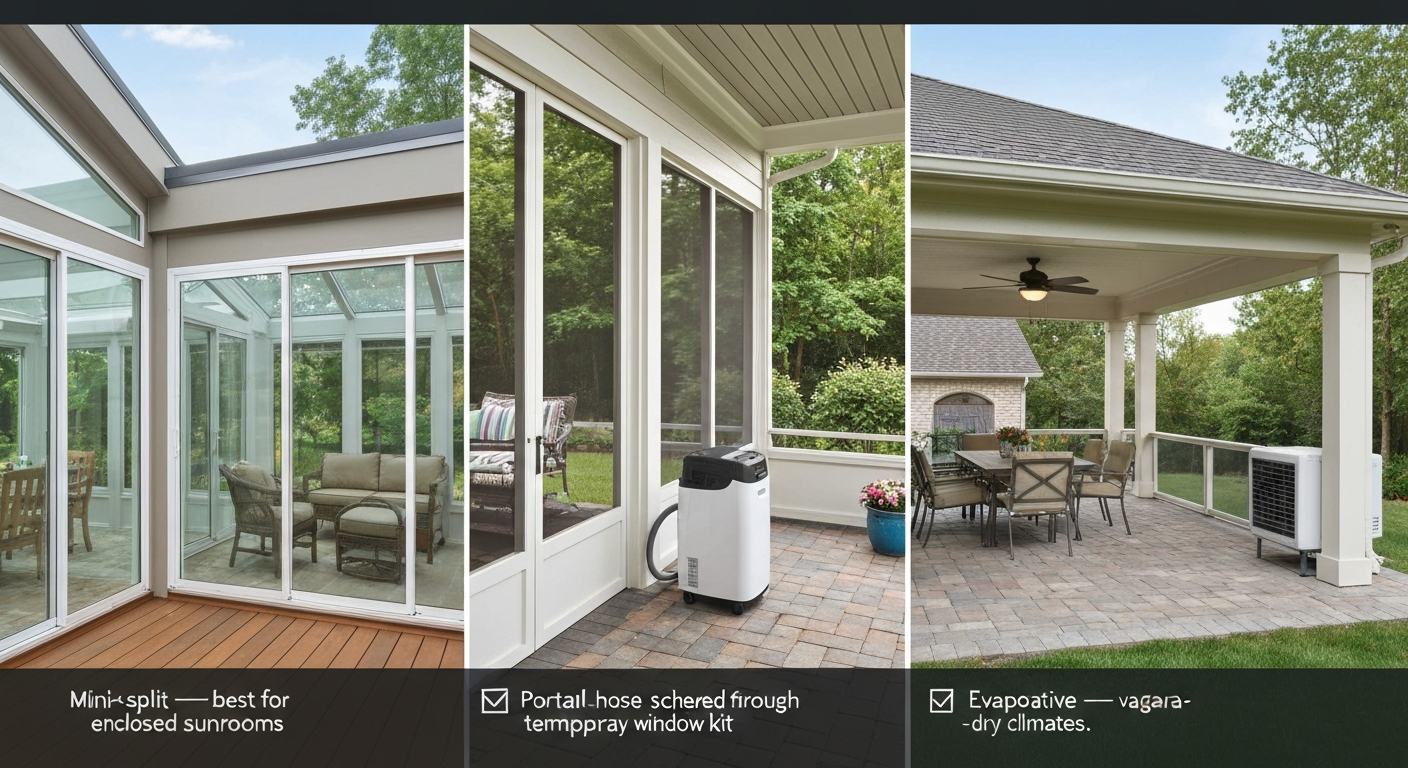
Quick takeaways: best picks by patio type and buyer priority
If you want to skip straight to a recommendation, here is how most homeowners land after researching patio cooling. These are not brand endorsements; they are category conclusions backed by the review patterns and real-world installation data you will find throughout this guide.
- Fully enclosed sunroom or patio room: ductless mini-split, sized with Manual J load calculation, installed by an HVAC-licensed contractor. Expect $2,500 to $6,000 installed. Reviews consistently cite efficiency, quiet operation, and ten-plus-year lifespan when a certified installer handles the refrigerant charge.
- Screened porch or lanai: portable air conditioner (dual-hose preferred) or a through-the-wall unit if the porch has a solid exterior wall. Budget $350 to $900 for the unit plus $0 to $600 for installation depending on wall work required.
- Covered open patio in a dry climate (below 60% relative humidity): evaporative (swamp) cooler, either portable or ducted. Very low operating cost, roughly $0.03 to $0.07 per hour. Useless in Florida, the Gulf Coast, or the Pacific Northwest.
- Covered open patio in a humid climate: misting fans or a ceiling fan with a high-velocity blade, not a refrigerant-based AC. No AC type performs well when there are no walls to hold cooled air.
- Budget-first buyers: a single-hose portable around 8,000 to 12,000 BTU for a screened space up to 350 square feet. Noisy and less efficient, but no installation needed.
- Efficiency-first buyers: look for ENERGY STAR certified models with a CEER (Combined Energy Efficiency Ratio) of at least 12.0, or a mini-split with a SEER2 rating of 18 or higher.
- Noise-sensitive buyers: mini-splits run as low as 19 dB(A) on the indoor head. ENERGY STAR's 'Most Efficient' tier requires 45 dB(A) or lower on lowest mode for room/window units.
How patio ACs differ from indoor units
An indoor window unit is designed for a climate-controlled interior where the only heat load is solar gain through windows, occupancy, and appliances. A patio is a fundamentally different problem. Direct sun exposure, radiant heat from concrete or pavers, wind infiltration, and wide temperature swings all increase the load beyond what standard BTU-per-square-foot rules suggest. A 12,000 BTU unit that comfortably cools 550 square feet of interior space may struggle with a 300-square-foot sunroom that has a glass roof and three glass walls facing south.
Beyond sizing, weatherproofing is the sharpest technical difference. Indoor units are not built to tolerate rain splash, humidity condensation on electrical components, or UV degradation of cabinet plastics. Units marketed specifically for patio or outdoor use carry IP (Ingress Protection) or NEMA enclosure ratings on their spec sheets. An IP44 rating means protection from objects larger than 1mm and water splashing from any direction. NEMA 3R means rain, sleet, and external ice. When you pull a spec sheet, look for those designations. If you cannot find them, the unit is not rated for exposed installation.
Code considerations are a third layer most homeowners do not anticipate. Installing any refrigerant-based system, including mini-splits, requires an EPA Section 608-certified technician to handle refrigerants under federal law. Many municipalities also require a mechanical permit for mini-splits and through-the-wall units, and some sunroom additions require a separate electrical permit for the dedicated circuit. If a contractor tells you permits are unnecessary, that is a red flag worth noting in a review.
Every patio AC type explained
Portable air conditioners
Portable units sit on the floor and exhaust hot air through a flexible hose vented to a window kit or a small wall penetration. Dual-hose models draw intake air from outside and exhaust out a second hose, which avoids the negative-pressure problem that makes single-hose portables less efficient. Consumer Reports' testing shows portables frequently deliver less than their advertised BTU when measured with DOE's newer test method (SACC, seasonally adjusted cooling capacity), so treat manufacturer BTU claims skeptically. A unit labeled 14,000 BTU may carry a SACC rating closer to 8,000 BTU. For screened porches and enclosed patios where you cannot mount a window or wall unit, a dual-hose portable is the most practical no-installation option.
Window and through-the-wall units
Window units mount in a double-hung or casement window opening and are the most cost-effective option per BTU for solid-walled spaces like screened porches with framed walls. Through-the-wall units are similar but require a dedicated wall sleeve, making installation more permanent and more expensive but also more airtight and quieter. ENERGY STAR-certified models in the 8,000 to 14,000 BTU range currently require a minimum CEER of 12.0 to 12.1 depending on capacity band. The ENERGY STAR product list, updated regularly by EPA, is the fastest way to verify whether a specific model qualifies without relying on manufacturer packaging.
Mini-split / ductless systems
A ductless mini-split pairs an outdoor compressor unit with one or more indoor air-handler heads mounted on the wall or ceiling. They are the gold standard for enclosed patio rooms and sunrooms because they are quiet (indoor units as low as 19 to 26 dB(A)), efficient (SEER2 ratings from 16 to 30-plus on leading models), and do not require ductwork. The tradeoff is cost: installation by a licensed HVAC contractor runs $2,500 to $6,000 for a single-zone system, more for multi-zone. AHRI certification is the key verification checkpoint here. The AHRI Directory lets you look up a matched outdoor/indoor system pair by model number to confirm the certified SEER2 and HSPF2 ratings, which is the only way to be sure a dealer is not quoting unmatched system efficiencies.
Evaporative / swamp coolers
Evaporative coolers work by pulling outside air through wet pads, dropping air temperature by 15 to 40 degrees Fahrenheit through water evaporation. They use roughly 75% less electricity than a refrigerant-based system of comparable airflow. The DOE is explicit, however: evaporative coolers are appropriate only in low-humidity climates. If your area's average summer relative humidity exceeds roughly 60%, the pads cannot evaporate fast enough to provide useful cooling. NOAA's 1991-2020 Climate Normals (available at NCEI) give you monthly mean humidity by station, which is the cleanest way to check suitability for your specific location rather than relying on general regional rules. Areas like Phoenix, Albuquerque, and Las Vegas are ideal candidates. Houston, Miami, and Atlanta are not.
| AC Type | Best Patio Fit | BTU Range | Typical Installed Cost | EER/SEER Range | Key Limitation |
|---|---|---|---|---|---|
| Portable (dual-hose) | Screened porch, semi-enclosed | 8,000–14,000 BTU (SACC) | $300–$750 (no install) | EER 8–11 | Noisy; hose limits placement |
| Window/through-the-wall | Screened porch with framed walls, small sunroom | 5,000–25,000 BTU | $200–$900 + install | CEER 12–14 | Requires window/wall opening |
| Mini-split / ductless | Sunroom, patio room, large screened enclosure | 9,000–36,000 BTU | $2,500–$6,000 installed | SEER2 16–30+ | Highest upfront cost; needs licensed installer |
| Evaporative cooler | Open/covered patio in dry climates | N/A (CFM-rated) | $150–$2,500 | N/A (uses ~¼ the energy) | Useless above ~60% RH |
| Through-the-wall commercial | Enclosed lanai, large patio room | 12,000–30,000 BTU | $600–$2,000 + install | EER 10–13 | Requires wall sleeve; permanent |
Match your patio type to the right AC: a decision flow
Walk through these steps in order. Each question narrows the field significantly and saves you from buying hardware you cannot use or that will underperform in your conditions.
- Is your patio fully enclosed with insulated walls and a ceiling? Yes: go to step 2. No (open, screened, or covered only): skip to step 5.
- Does your enclosed patio room (sunroom or patio room) have existing HVAC ductwork? Yes: extend your home's system with a dedicated zone if the blower capacity allows, or add a supplemental window unit. No: a ductless mini-split is almost always the right call. Get at least two bids from AHRI-certified contractors.
- Is your enclosed space larger than 400 square feet or does it have significant glass (more than 50% of wall area is glazed)? Yes: upsize your BTU estimate by 20 to 30% beyond standard rules of thumb, or commission a Manual J calculation. No: standard sizing applies (roughly 20 BTU per square foot adjusted for local climate using NOAA normals).
- Do you need heat as well as cooling? Yes: a mini-split heat pump handles both. A heat-pump mini-split with a HSPF2 above 9.0 is a solid year-round solution for three-season or four-season patio rooms. No: cooling-only units are less expensive.
- Is your patio screened or partially enclosed (screened porch, lanai with screen walls)? Yes: a portable dual-hose or a through-the-wall unit (if there is a solid knee wall) will work. Move to step 6.
- Is your screened porch climate in the dry Southwest (Phoenix, Tucson, Albuquerque, Las Vegas, El Paso)? Yes: a portable evaporative cooler is effective and cheap to run. No: portable AC or through-the-wall is necessary for meaningful cooling.
- Is your patio completely open (no enclosure or screening)? Refrigerant-based AC is not practical. High-velocity ceiling fans, misting systems, or a shade sail/pergola with fans are your realistic options. Consider whether adding a screen or patio enclosure would change this calculus. Patio enclosure companies listed on Pool And Patio Reviews can quote screen room additions in most markets.
The review criteria that actually matter
When you are reading reviews or comparing products, not every spec carries equal weight. Here is how I think about the nine factors that show up consistently in genuine homeowner reviews.
BTU and coverage
Never accept a manufacturer's BTU-to-room-size chart at face value for a patio application. The standard 20 BTU per square foot rule is derived from conditioned interior spaces with insulated walls and controlled infiltration. Sunrooms and screened porches have higher solar gain, higher infiltration, and often no ceiling insulation. A simple adjustment: add 10% for direct southern or western sun exposure, 20% for significant glass area, and cross-check against NOAA's Climate Normals for your city's design dry-bulb temperature. If your local July mean high exceeds 95°F, apply a further 10 to 15% upsize. For portable units specifically, use the DOE's SACC rating, not the gross BTU figure, because Consumer Reports' lab testing has consistently shown gross BTU figures can overstate effective cooling by 30 to 50%.
EER and SEER: what the numbers mean in dollars
EER (Energy Efficiency Ratio) is cooling output divided by power input at a single test condition (95°F outdoor, 80°F indoor, 50% RH). CEER adds standby power to the calculation. SEER2 (used for mini-splits and central systems) measures seasonal performance across a range of temperatures, making it more representative for year-round climates. The practical impact: a mini-split with SEER2 of 22 versus 16 saves roughly $90 to $140 per year in cooling costs on a 12,000 BTU zone run 1,000 hours annually at the national average electricity rate. Over ten years, the efficiency gap pays for a meaningful portion of the unit's price premium. Always verify EER/SEER numbers against the AHRI Directory or ENERGY STAR qualified product list rather than the product packaging.
Weather and outdoor ratings
The outdoor compressor unit in a mini-split is designed for outdoor placement, but the indoor air handler is not. For screen rooms and patios where humidity and insects are a factor, confirm whether the indoor head has any IP rating or is specified for high-humidity environments. Portable and window units marketed for patio use should list their IP or NEMA rating in the spec sheet. If the spec sheet does not mention it, the unit has no such rating and should not be exposed to rain or heavy condensation.
Noise
Noise matters enormously on a patio where you are trying to have a conversation or relax. The ENERGY STAR 'Most Efficient' designation for room air conditioners requires 45 dB(A) or lower on the lowest fan mode. Mini-split indoor heads from leading manufacturers typically run 19 to 26 dB(A) on low. Portable units are the loudest category, often 52 to 58 dB(A), which is approximately the volume of a normal conversation. When manufacturers cite noise figures, ask which test standard was used. ISO 3744 is the internationally recognized method for sound power determination. If the spec sheet says only 'dB' without specifying distance, test condition, or standard, the number is not comparable to other products and should be treated with skepticism.
Maintenance requirements
Patio environments are harder on equipment. Insects, pollen, cottonwood, and blowing debris clog filters and coils faster than indoor installations. Filter-cleaning intervals that manufacturers suggest quarterly for indoor use may need to be monthly on a porch or in a high-pollen region. Mini-splits require an annual professional inspection of the refrigerant charge, electrical connections, and condensate drain. Portables need their condensate reservoirs drained or checked depending on the drain method. Check the installation manual (downloadable from the manufacturer's product page) for maintenance schedules before you buy.
Installation complexity and permit requirements
A portable unit requires zero installation. A window unit takes 30 minutes. A through-the-wall unit requires cutting a 16-by-26-inch rough opening, framing the wall sleeve, and making electrical connections, typically a 2 to 4 hour job for a contractor. A mini-split involves mounting brackets, drilling a 3-inch lineset penetration, running refrigerant lines, and commissioning the refrigerant charge, which requires an EPA Section 608 certification. Budget $500 to $1,500 for mini-split installation labor on top of the equipment cost, plus permit fees that typically run $75 to $200 depending on municipality.
Warranty and post-sale service
Parts and labor warranty durations vary widely. Most window and portable units carry a one-year limited warranty with a five-year compressor warranty. Mini-splits from established manufacturers offer five to twelve years on compressor and parts when installed by a manufacturer-authorized dealer and registered within 30 to 90 days of installation. Always download the exact warranty PDF from the manufacturer's website, not the retailer's summary. Check whether the warranty is transferable (matters for resale), whether it requires annual professional maintenance to remain valid, and whether it covers the labor cost of a repair or just parts. These details live in the fine print and are frequently the source of negative reviews.
| Review Criterion | What to Check | Where to Verify |
|---|---|---|
| BTU / Coverage | SACC rating (portables) or Manual J sizing | DOE energy guide label; AHRI Directory |
| EER / CEER / SEER2 | Meets or exceeds ENERGY STAR minimums | ENERGY STAR qualified product list; AHRI Directory |
| Weather/IP rating | IP44+ or NEMA 3R for any outdoor-exposed component | Manufacturer spec sheet / installation manual |
| Noise (dB) | ISO 3744-compliant test; ≤45 dB(A) on low for room units | Manufacturer spec sheet; Consumer Reports lab data |
| Maintenance intervals | Filter cleaning, coil cleaning, condensate drain schedule | Installation manual (download from OEM site) |
| Installation complexity | Permit required? Licensed HVAC needed? Wall work? | Local building department; contractor bid |
| Energy operating cost | Estimated annual kWh and cost at local rate | ENERGY STAR energy guide; EER × hours ÷ 1,000 × $/kWh |
| Warranty terms | Duration, labor coverage, registration requirements, transferability | Manufacturer warranty PDF (OEM site) |
| Post-sale service | Authorized dealer network; local service availability | Manufacturer dealer locator; BBB; Pool And Patio Reviews |
How to read and weigh verified customer reviews
A five-star average on a product or contractor listing can mean excellent quality or it can mean excellent reputation management. Here is how to separate signal from noise.
What to trust
Reviews that describe specific outcomes carry more weight than general sentiment. A review that says 'installer drilled the lineset in the wrong location on the first attempt, then corrected it and cleaned up perfectly' tells you something actionable. One that says 'great company, very professional' tells you almost nothing. Look for reviews that mention timelines (quoted versus actual), cost accuracy (bid versus final invoice), permit handling, equipment brand and model, and whether the contractor returned for any follow-up issues. These are the details that distinguish experienced, honest contractors from mediocre ones who happened to get lucky on a simple job.
Red flags in reviews
- A cluster of five-star reviews posted within a one- to two-week window with no prior review history, especially if reviewer accounts are new.
- Reviews that use identical or near-identical phrasing across multiple accounts. Academic research on opinion spam detection identifies duplicate text patterns as one of the strongest signals of coordinated fake reviews.
- Reviewer profiles with only one review (the one for the company in question), no photo, and a generic name.
- Responses from the business that offer discounts, gift cards, or free services to reviewers. Under FTC endorsement rules, any review posted in exchange for compensation must be disclosed. A business that rewards reviews without requiring disclosure is operating outside FTC guidelines.
- Sudden rating drops followed by an explanation-free rating recovery. This pattern often indicates a round of negative reviews that were contested or removed rather than genuinely resolved.
- Exclusively positive reviews for a contractor with no mention of any challenges. Real projects always have some friction. Reviewers who mention a small problem and how it was handled are usually more credible than those with uniformly flawless experiences.
Handling outliers and regional service trends
A single one-star review on an otherwise strong profile is not necessarily disqualifying, especially if the business responded professionally and the complaint appears to involve an unusual circumstance. What matters more is the pattern. If four of eighteen reviews mention the same problem (say, the contractor did not pull permits or the unit was undersized), that is a pattern, not an outlier. Regional trends also matter in ways that national review aggregates obscure. A patio enclosure contractor who earns strong reviews in Dallas and weak reviews in Houston may be operating at the edge of their service radius when they take on Gulf Coast jobs where humidity loads are dramatically higher. Filter reviews by your metro area before drawing conclusions about quality.
Getting the most out of Pool And Patio Reviews
Pool And Patio Reviews aggregates contractor and dealer reviews across North America, with a focus on verified customer experiences for patio companies, sunroom builders, and outdoor living specialists. Using it effectively requires a few habits beyond just reading the star rating.
Search and filter tips
- Search by your city or ZIP code, not just the brand name. A dealer with excellent national reviews may have limited service technicians in your specific market, and local reviews will reflect that.
- Filter by service type. 'Patio enclosure installation' and 'patio air conditioning installation' are different service categories that may involve different subcontractors even at the same company.
- Sort by date, not by rating. Recent reviews are more relevant because contractor quality, staff, and ownership can change. Reviews older than two years deserve a lower weighting for current hiring decisions.
- Read the one- and two-star reviews first. They take less time to read than the five-star pile and reveal failure modes faster.
- Look for Pool And Patio Reviews' verification badge or provenance label. The platform cross-references reviews against original platforms like Google, Angi, and BBB. If a review on Pool And Patio Reviews shows provenance, you can trace it back to its original source to confirm the account history.
Spotting fake or incentivized reviews
Use the same red-flag checklist from the section above on any review platform. See the blank" rel="noopener noreferrer">FTC’s Endorsements, Influencers, and Reviews for authoritative guidance on disclosure requirements, fake or incentivized reviews, and verification steps. On top of that, check whether the company has a history of contesting legitimate reviews or requesting removals. On BBB profiles, look for 'complaint history' and 'complaint response rate,' which is separate from the review score and more difficult to manipulate. If you find a review on Pool And Patio Reviews that appears to be incentivized or fraudulent, check whether the text matches a review posted on Google or Angi under the same reviewer name. Academic research identifies duplicate/near‑duplicate text, reviewer‑behavior anomalies, rating bursts, and extreme rating deviation as practical fraud signals (see blank" rel="noopener noreferrer">Opinion Spam Detection resources (Bing Liu research page)). If the text is identical but the reviewer claims different experiences, that is a strong fraud indicator worth reporting.
When and how to file a report
If you complete a project with a patio AC installer or dealer and your experience materially differs from how the company is represented in its Pool And Patio Reviews profile (for example, they have a four-star average and your experience was significantly worse, or you observed permit violations), you can submit a verified review directly through the platform. Be specific: include dates, contract amounts, what was promised versus delivered, and whether the contractor returned to address problems. You can also file a complaint with your state contractor licensing board if permit or licensure violations occurred, and with the FTC if you believe the company is running a coordinated fake review operation.
Brand and dealer review roundup: Duracool, Sunline, Sunscape, Sunshine, and Trueline
These five brands and dealer networks appear frequently in patio-related contractor searches on Pool And Patio Reviews, and each has a distinct regional footprint and product focus. What follows is a framework for what to look for in their verified reviews, not a definitive rating, because review quality and service density vary significantly by market. If you are researching any of these companies in your area, the verified review profiles on this site are a starting point, but cross-reference with local BBB listings and the manufacturer's authorized dealer locator before committing.
What to look for in verified reviews across all five brands
- Did the contractor perform a load calculation, or did they size the unit based purely on square footage? Reviews that mention a 'heat load assessment' or 'Manual J' indicate a more sophisticated installation approach.
- Was the unit registered with the manufacturer within the required window for extended warranty coverage? Several negative reviews across patio brands cite warranty disputes that trace back to delayed or missed registration.
- Did the installer pull the required mechanical and electrical permits? In most jurisdictions, a mini-split installation requires at minimum a mechanical permit. Reviews mentioning 'no permit needed' from a contractor are a warning sign.
- How did the company handle service calls after installation? Post-installation responsiveness is the single most consistent differentiator between top-rated and mediocre contractors across all five brands.
- Is the dealer listed on the manufacturer's authorized installer locator? Verify this independently. An authorized dealer has access to manufacturer technical support and warranty processing. A third-party dealer installing the same equipment may void certain warranty terms.
Duracool
Duracool reviews on Pool And Patio Reviews tend to concentrate in Sun Belt markets. When reviewing Duracool dealer profiles, pay particular attention to reviews that mention the enclosure build quality versus the cooling system performance separately. Duracool's product line spans enclosure materials and HVAC integration, and reviews that conflate construction quality with AC performance can mislead. Look for reviewers who specifically address the cooling system's performance in summer heat, whether the unit was properly sized for glass-heavy enclosures, and whether post-sale service was handled locally or required corporate involvement.
Sunline
Sunline patio reviews frequently surface feedback about the interaction between their enclosure systems and add-on HVAC components. Because many patio enclosure companies offer cooling as an add-on rather than a core product, the quality of the HVAC subcontractor matters as much as the company's primary enclosure work. In verified Sunline reviews, filter specifically for mentions of the cooling system and note whether the HVAC work was performed by the same crew or a subcontractor. Subcontracted HVAC work with less direct accountability to the primary contractor is a recurring theme in lower-rated installations across multiple patio brands.
Sunscape Patio Rooms
Sunscape's verified reviews show a pattern that is worth investigating in your own local market: strong ratings for the enclosure construction itself and more mixed results when the cooling system is part of the same contract. In particular, look for reviews that address how well the HVAC unit was integrated with the enclosure's ventilation design, whether any wall penetrations were properly sealed and flashed against weather infiltration, and whether the cooling system was commissioned and tested before the crew left the site.
Sunshine Patios
Sunshine Patios reviews that mention air conditioning tend to cluster around screened room and lanai builds in southeastern markets. In high-humidity regions like Florida and the Gulf Coast, the choice of AC type matters more than almost anywhere else because evaporative cooling is not viable and mini-splits must handle extreme latent (humidity) loads. In Sunshine's verified reviews, note whether reviewers comment on humidity control indoors, whether the system was dehumidifying effectively, and whether the contractor specified a unit with a dedicated dehumidification mode. Systems that cool adequately but leave the air feeling damp are a common complaint in these markets.
Trueline Patios
Trueline Patios reviews in the Pool And Patio Reviews database are worth examining for regional service network depth. For any patio contractor offering HVAC integration, the ability to respond quickly to a service call six months after installation depends heavily on having local technicians rather than relying on factory service or warranty-provider call centers. In Trueline reviews, look for any pattern of slow post-installation service response, and compare that against the geographic concentration of the reviews. A contractor with strong reviews in their home market and weaker ones in outlying areas is often operating at the limits of their service radius.
Comparing the five brands on service factors
| Brand | Primary Focus | AC Integration Approach | Key Review Signals to Watch | Regional Concentration |
|---|---|---|---|---|
| Duracool | Patio enclosures + HVAC | Often bundled with enclosure sale | Cooling performance vs. construction quality in reviews; Sun Belt focus | Sun Belt, Southeast |
| Sunline | Patio enclosures | AC sometimes subcontracted | HVAC subcontractor quality; post-sale service chain | Multi-regional |
| Sunscape Patio Rooms | Patio rooms / sunrooms | HVAC often add-on or integrated design | HVAC commissioning quality; wall penetration sealing | Southeast, Mid-Atlantic |
| Sunshine Patios | Screen rooms, lanais | Mini-splits or portable as add-on | Dehumidification performance in humid climates; latent cooling | Florida, Gulf Coast, Southeast |
| Trueline Patios | Patio enclosures and covers | HVAC integration varies by market | Service network reach beyond home market; response times | Varies; check local coverage |
Contractor interview checklist before you hire
Before signing any contract for a patio AC installation, ask these questions directly. A contractor who cannot answer most of them clearly probably lacks the experience to back their bid.
- Are you EPA Section 608 certified to handle refrigerants? (Required for any mini-split or refrigerant-based installation.)
- Will you pull a mechanical permit for this installation, and who is responsible for scheduling the inspection?
- How did you determine the BTU size for my space? Did you use Manual J, or a rule-of-thumb calculation?
- Is the equipment you are specifying AHRI certified? Can you provide the AHRI certificate or directory listing for the matched system?
- What is the manufacturer's warranty, and will you register the equipment in my name within the required window?
- Are you an authorized dealer or installer for this equipment manufacturer? How do I verify that on the manufacturer's website?
- What is your labor warranty on the installation work itself?
- Do you have local service technicians, or is warranty service handled through a third-party call center?
- Can you provide three references from patio or sunroom AC installations completed in the past 12 months, specifically in a similar patio type to mine?
- What is the condensate drainage plan, and how will you prevent water infiltration at any wall or roof penetrations?
Cost ranges: unit, installation, and operating
These ranges reflect mid-2026 market conditions in North America. Local labor costs, permit fees, and equipment availability vary considerably, so treat these as planning benchmarks, not firm quotes.
| AC Type | Unit Cost | Installation Cost | Estimated Annual Operating Cost (1,000 hrs) | Total First-Year Cost |
|---|---|---|---|---|
| Portable dual-hose (12,000 BTU SACC) | $400–$750 | $0 (self-setup) | $130–$180 | $400–$930 |
| Window/through-the-wall (12,000 BTU) | $280–$600 | $100–$600 | $120–$160 | $400–$1,360 |
| Mini-split single-zone (12,000 BTU, SEER2 18) | $900–$1,800 (equipment) | $1,200–$2,500 (labor + permit) | $75–$110 | $2,175–$4,410 |
| Mini-split single-zone (12,000 BTU, SEER2 24+) | $1,200–$2,500 (equipment) | $1,200–$2,500 (labor + permit) | $55–$85 | $2,455–$5,085 |
| Portable evaporative cooler (large) | $150–$600 | $0–$200 | $20–$50 | $150–$850 |
The operating cost estimates above assume 1,000 cooling hours per year (roughly a 3.5-month cooling season at 8 hours per day), a national average electricity rate of approximately $0.16 per kWh, and a 12,000 BTU cooling load. Your actual costs will vary based on local electricity rates, how many hours the unit runs, and how well the space is sealed and insulated. In hotter markets like Phoenix or Houston, 1,500 to 2,000 annual cooling hours is a more realistic assumption, which can double the operating cost difference between a low-efficiency and high-efficiency unit.
Your next steps
Start with the decision flow above to narrow your AC type, then verify your sizing against NOAA's Climate Normals for your area and confirm the unit's ratings in the AHRI Directory or ENERGY STAR qualified product list. When you have a shortlist of units and a contractor or dealer in mind, search Pool And Patio Reviews by your ZIP code and filter for recent, verified reviews with specific detail about cooling performance, permit handling, and post-installation service. Cross-check the contractor's BBB listing and confirm their authorized dealer status directly on the manufacturer's website. If the contractor is one of the five brands covered here, compare their local reviews against the regional patterns outlined above. A well-chosen, properly installed patio air conditioner should last ten to fifteen years with routine maintenance. The 30 minutes you spend reading verified reviews and asking the right questions before you sign is almost always worth it.
FAQ
What primary technical data do I need to verify when preparing an evidence‑based buyer’s guide for patio air conditioners?
Collect model‑level certified cooling capacity (BTU/h), EER/SEER/CEER/COP, test conditions, refrigerant type, declared airflow (CFM), sound levels (dB) with test method & distance, IP/NEMA or weather enclosure rating, condensate handling method, installation requirements (clearances, power), and warranty text. Source each datum to the manufacturer spec sheet and installation manual, and verify performance numbers against AHRI Directory entries or equivalent third‑party lab certificates before quoting them.
Which authoritative external sources should I use to verify manufacturer claims and why?
Use AHRI Directory/Certification for independently tested capacity and efficiency; ENERGY STAR product lists/specs for efficiency/noise thresholds and qualified products; DOE (Energy Saver/HomeCooling101) for system types, sizing guidance (Manual J reference), and climate suitability; EPA SNAP for refrigerant acceptability; ISO 3744 for correct acoustics test method; Consumer Reports and other independent lab reports for measured cooling/noise data; and independent test labs (Intertek, UL) for specific test reports or certificates. Cite each source and archive the exact record or PDF for traceability.
How should I verify noise (dB) claims so different models are comparable?
Require noise measurements reported to ISO 3744 (or equivalent) with the test condition documented (mode, fan speed), measurement distance, and whether dB(A) or dB(C) weighting was used. If only manufacturer dB is available without method, treat it as low‑confidence. Prefer Consumer Reports or lab certificates that show measurement method. When summarizing, always list the test standard and measurement distance alongside dB numbers.
What steps confirm a model’s refrigerant and environmental compliance?
Check the model spec sheet/manual for stated refrigerant, then cross‑reference the refrigerant against EPA SNAP acceptability and recent SNAP rule changes. If the refrigerant or charge size is unclear, request the OEM’s compliance/test report or AHRI record. Flag any models using phased‑out or restricted refrigerants and note service/retrofit implications and legal constraints.
How do I assess real‑world operating cost and sizing accuracy for patio spaces?
Start with Manual J sizing principles: use NOAA/NCEI climate normals for location‑specific design temperatures and humidity to adjust sensible load per square foot. Use certified BTU ratings and expected runtime hours for your climate to estimate seasonal kWh (use EER/CEER to convert BTU to watts). Include water use for evaporative coolers. Provide cost ranges using local electricity rates (source: EIA or local utility) and show worked examples for typical patio sizes and climates.
What verification is required for brand/dealer network claims (Duracool, Sunline, Sunscape, Sunshine, Trueline)?
Use each manufacturer’s 'Find a Dealer/Authorized Installer' tool to list claimed dealers in target regions. Cross‑check those names with state contractor license databases, BBB/Angi/Yelp/Google listings, and PoolAndPatioReviews entries. Request and archive OEM authorization letters or dealer agreement pages if a brand claims exclusive authorized networks. Note gaps between claimed coverage and actual licensed contractors; report regional service density per brand.
Next Articles
Sunshine Patios Reviews: Honest Guide for Homeowners - Costs & Comparisons
Sunshine Patios reviews: verified customer pros/cons, costs, warranties, red flags, and a hiring checklist for owners.
Trueline Patios Reviews: Ratings, Pros, Cons & Buying Guide
Trueline Patios reviews: verified customer ratings, pros/cons, pricing factors, comparisons, buyer checklist.

Sunline Patio Reviews: Honest Aggregate Ratings & Guide
sunline patio reviews: aggregated ratings, real customer excerpts, pros/cons, cost signals, dealer checklist & FAQs