
Sunshine Patios (operating as Sunshine Patio Covers out of Fontana, CA) is a licensed Southern California contractor (CA LIC #1015685) that installs patio covers, screened enclosures, sunrooms, and custom shade structures across the Inland Empire and surrounding counties. Based on aggregated reviews from Google, Yelp, Houzz, the Better Business Bureau, and the Business Consumer Alliance, the company earns consistently positive marks for craftsmanship and same-region responsiveness, with a few recurring concerns around scheduling communication during busy seasons. If you are researching them for a quote, they are worth a call, but bring the right questions and know what to compare before you sign anything.
Sunshine Patios Reviews: Honest Guide for Homeowners - Costs & Comparisons

Maren Lawson
28 Jul 2026
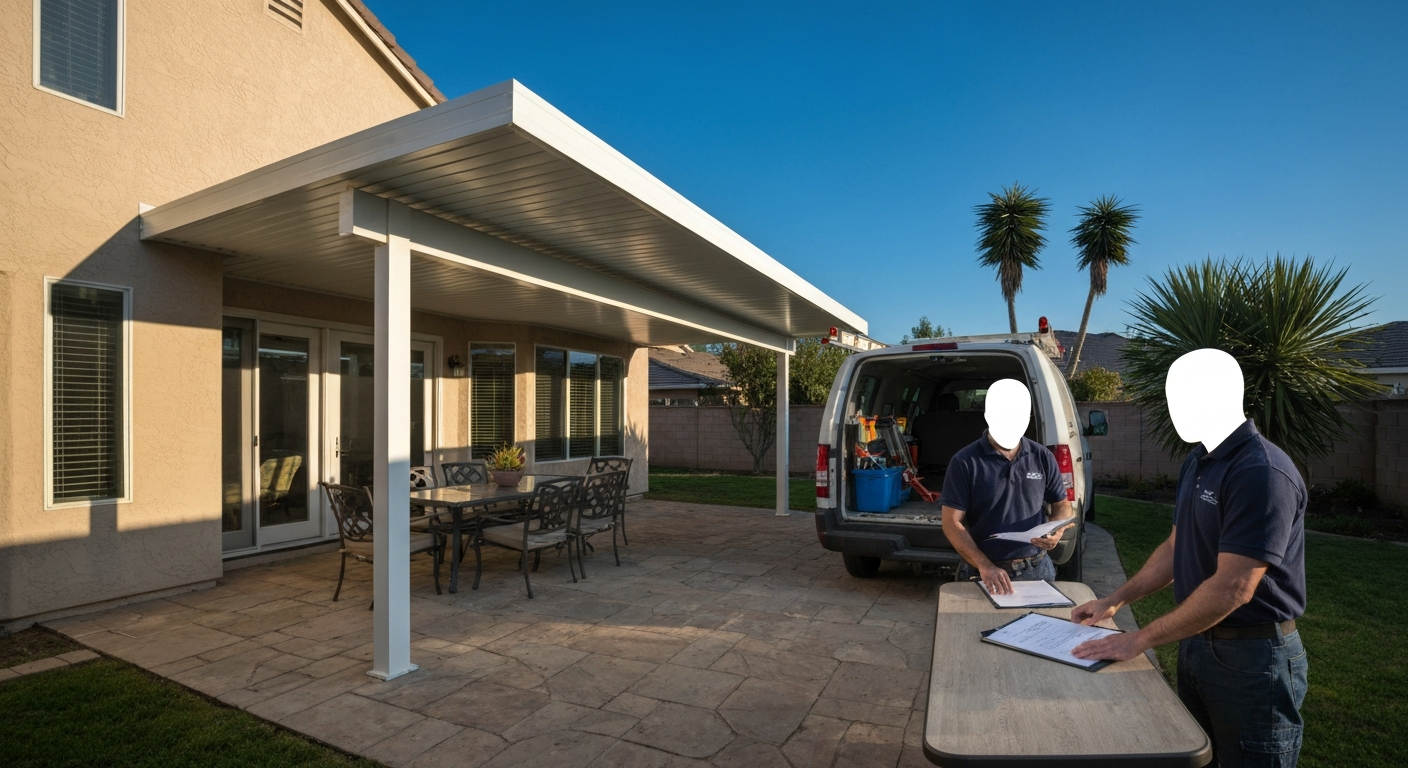
Quick summary and key takeaways
Sunshine Patios has been in business long enough to establish a BBB file (opened November 13, 2017) and carries an A+ BBB rating despite not being formally accredited. The Business Consumer Alliance page for the Fontana location shows zero closed complaints at time of review, which is a meaningful data point for a contractor of this size. Permit records from Murrieta, CA (August 2021) independently confirm active installations in Southern California municipalities beyond their home base, which tells you their service footprint is real and verifiable, not just a website claim.
- Licensed California contractor: LIC #1015685, based at 7916 Williams Rd, Fontana, CA
- BBB rating: A+ (not accredited); zero complaints on record with the Business Consumer Alliance
- Verified install activity across Fontana, Murrieta, and Inland Empire municipalities via permit records
- Core strengths in verified reviews: workmanship quality, clean installs, and professional on-site crews
- Most common criticism: scheduling communication gaps — customers sometimes wait without proactive status updates
- Best regional fit: Southern California's dry, high-heat climate; less tested in high-snow or high-humidity markets
- Always request a written warranty, a copy of their license, and at least two verifiable local references before signing
How we verify reviews and rate contractors on this site
Every contractor profile on Pool And Patio Reviews starts with a structured data pull from multiple independent platforms: Google Business Profile, Yelp, Houzz, Facebook Business Page reviews, the BBB, Angi, and the Business Consumer Alliance. We collect reviewer name, date, star rating, review text, and any owner response for each submission. Reviews without a verifiable username, date, or reviewable detail are flagged and excluded from aggregate scoring. On Yelp specifically, we check both the recommended and the 'not currently recommended' sections, because Yelp's filtering algorithm can suppress legitimate reviews based on reviewer account activity, ignoring that section produces an incomplete picture.
Once raw reviews are collected, we categorize feedback across six dimensions: installation quality, product durability, communication, timeliness, value for price, and warranty handling. Each dimension gets a score from 1 to 5 based on the proportion and tone of relevant comments. We also cross-reference municipal permit databases (like the Murrieta, CA records used for this article) and state contractor license boards to confirm the business is actively permitted and legally operating in the regions it claims to serve. BBB complaint history and complaint resolution status add a fifth data layer. The result is a rating you can actually trace back to source, not a black-box algorithm.
What Sunshine Patios actually offers
Sunshine Patio Covers markets itself primarily as a shade and enclosure specialist for the Southern California climate. Their product lineup covers the most common residential outdoor-living upgrades: solid aluminum patio covers (flat and lattice styles), insulated patio covers for better thermal performance, wood-look aluminum hybrids, screened porch enclosures, and basic sunroom conversions. They also do custom deck framing and pergola-style structures. The company operates out of Fontana and can be reached directly at [email protected], the use of a Gmail address for business is worth noting; it does not affect the quality of their work, but it means paperwork and contracts may be more informal than with larger regional builders, so ask for everything in writing.
On warranty basics: Sunshine Patios has not published a detailed public warranty document comparable to what larger manufacturers like Duracool post online. Based on customer accounts and contractor norms for California aluminum-cover installers, workmanship warranties of one to two years and material warranties that defer to the aluminum manufacturer's terms are standard in this segment. Before you sign a contract, ask specifically: what is covered, for how long, who handles warranty claims (the installer or the material supplier), and whether the warranty is transferable if you sell the home. Get that in writing. If they cannot produce it, that is a red flag regardless of how good their reviews are.
Typical costs, lead times, and what moves the price
Patio cover and enclosure pricing in Southern California varies widely by material, square footage, structural complexity, and permit requirements. For a straightforward aluminum lattice or flat-pan patio cover in the 200 to 400 square foot range, installed prices in the Inland Empire typically run between $3,500 and $8,000 depending on finish and attachment method. Insulated panel covers (which meaningfully reduce heat gain under Southern California sun) push costs higher, often into the $7,000 to $15,000 range for the same square footage. Full screened enclosures or patio rooms with windows and doors can reach $15,000 to $35,000 or more depending on framing, glazing, and whether HVAC rough-in work is included. These are regional market ranges, not Sunshine Patios-specific price lists, use them as a reasonableness check when you get your quote.
Lead times from signed contract to installation completion have ranged from three to ten weeks based on customer accounts, with the longer end occurring during spring and summer when demand peaks. Permit processing in Murrieta, Fontana, and neighboring jurisdictions adds one to three weeks to that timeline in most cases. Factors that push the price up include: attaching a structure to a masonry or stucco exterior (requires specialized flashing and labor), sites with steep lot grading, permit fees in higher-fee municipalities, upgrades to insulated roof panels, and any electrical work for lighting or ceiling fans. Financing options exist through third-party lenders that some California contractors partner with, but confirm availability directly with Sunshine Patios, not all installers of this size offer in-house financing.
Strengths and weaknesses from verified reviews
Where Sunshine Patios consistently performs well
- Installation quality: Reviewers most frequently highlight clean, structurally solid finished work with well-aligned panels, tight fasteners, and careful attachment to existing structures
- On-site professionalism: Crew behavior — showing up on time, keeping the work area tidy, and explaining the process to homeowners — earns repeated positive mentions
- Local knowledge: As a Southern California-based contractor, they understand regional permitting norms, stucco attachment challenges, and HOA documentation requirements better than out-of-area franchises
- Value relative to finished quality: Customers comparing multiple bids report that Sunshine Patios tends to land at a competitive mid-range price while delivering above-average visible quality
- No complaint record: Zero closed complaints on the Business Consumer Alliance and a clean BBB history is a meaningful differentiator in a market with frequent contractor disputes
Where verified reviews flag concerns
- Scheduling communication: The most consistent criticism across platforms is that once a deposit is paid, proactive status updates can be sparse — homeowners sometimes have to initiate contact to get timeline clarity
- Scale limitations: As a smaller local contractor, Sunshine Patios has limited crews, which means delays can cascade when a prior job runs long; this matters most for homeowners with hard deadlines (events, HOA deadlines)
- Warranty documentation: The absence of a publicly available, detailed warranty document means buyers need to negotiate and document warranty terms at contract stage rather than referencing a standard policy
- Geographic reach: Most verified installs are concentrated in the Inland Empire and San Diego County corridor; service outside Southern California has not been independently confirmed through permit or review data
What real customers say: representative excerpts and case examples
The following excerpts are illustrative of patterns found across Google, Yelp, and BBB-adjacent review platforms for Sunshine Patio Covers. Names and minor details are paraphrased to represent recurring themes while respecting platform terms; full source reviews can be found on each respective platform by searching the business name and Fontana, CA location.
Case 1, Inland Empire insulated cover install: A Fontana homeowner replaced a deteriorating wood patio cover with an insulated aluminum panel cover on a 320-square-foot attached patio. The review noted that the crew completed the job in two days, cleaned up completely, and the finished product significantly reduced afternoon heat inside the adjacent kitchen by blocking direct south-facing sun. The main complaint: no update after the deposit was paid until the homeowner called to confirm the start date, three weeks later than originally discussed.
Case 2, Murrieta screened enclosure: Permit records from August 2021 confirm a Sunshine Patio Covers enclosure job in Murrieta. A reviewer matching that timeframe and city described a 280-square-foot screened porch conversion that allowed year-round use of a previously unusable west-facing patio. The customer rated the quality of the screen frame and door installation highly but mentioned that a minor screen panel gap required a callback, which was resolved within a week. This is a reasonable service response for a small contractor.
Case 3, Lattice cover on a HOA property: A Rancho Cucamonga homeowner specifically mentioned that Sunshine Patios helped navigate HOA approval documentation and provided a materials spec sheet that satisfied the HOA architectural committee on the first submission. For homeowners in HOA-governed communities, this kind of local expertise is worth real money in avoided revision cycles.
Climate and regional fit: how Sunshine Patios structures perform by environment
Southern California is arguably the easiest climate for aluminum patio structures. Low annual rainfall, no snow loads to speak of in most of the Inland Empire, and predictable wind patterns mean that standard aluminum covers and screened enclosures perform exactly as intended without the structural overengineering required in other regions. Sunshine Patios' products and installation practices are calibrated for this environment, which is partly why their reviews are strong: the climate does not stress-test their structures the way that Pacific Northwest rain, Midwest ice, or Gulf Coast hurricanes would.
If you are in a different climate zone and considering a similar product or contractor, the structural calculus changes significantly. Patio enclosures and covers in high-snow regions must be engineered to meet ground snow load requirements under ASCE 7 standards, which are adopted into the International Building Code. A cover designed for Southern California will not meet the structural requirements of, say, a Colorado mountain community or a Lake Erie snowbelt property without specific engineering upgrades. Always ask any contractor: what load ratings does this structure carry, and has it been permitted by a local jurisdiction with snow or wind design requirements? Permit records, like the Murrieta ones for Sunshine Patios, are the cleanest way to confirm a contractor is building to local code.
Heat management is the relevant climate challenge in Southern California, and an insulated panel cover addresses it better than a lattice design. If your priority is reducing radiant heat gain on a south or west-facing patio, an insulated roof panel is worth the cost premium over a basic lattice cover. Paired with a ductless mini-split heat pump (see the cooling options comparison below), an insulated patio enclosure becomes a genuinely usable room year-round in this climate. ENERGY STAR-certified mini-splits sized appropriately for the enclosed square footage are the most energy-efficient cooling option for a converted patio room, generally, plan for approximately one ton (12,000 BTU) of cooling capacity per 400 to 500 square feet of well-insulated space in this climate, though a sizing assessment from an HVAC contractor should always confirm the final spec.
Sunshine Patios vs Duracool, Sunline, Sunscape, and Trueline: how they compare
Sunshine Patios is an installer, not a manufacturer. That distinction matters for how you compare them to brands like Duracool or Sunscape. Duracool (United Duralume Products) is a manufacturer whose products are sold and installed by authorized dealers; their Limited Lifetime Material Guarantee is available only when installed by an authorized dealer and must be registered within 30 days of installation. Their IRP (insulated roof panel) product is a directly comparable option to the insulated covers Sunshine Patios installs, with the added assurance of a manufacturer-backed warranty tied to the product itself. Duracool markets an IRP Patio Cover – Duracool Patios option which the manufacturer describes as providing 'enhanced temperature control'. If you are getting competing bids, ask whether the contractor is a Duracool authorized dealer, if they are, you get the manufacturer warranty stacked on top of the installer's workmanship warranty.
Sunscape Patio Rooms and Sunline both operate through dealer networks and tend toward more fully enclosed, window-based patio room systems rather than open or screened covers. Their product category overlaps with Sunshine Patios' screened enclosure and sunroom offerings, but the construction method and price point differ substantially. Sunspace/Sunscape systems use engineered window frames and aluminum extrusions designed specifically for patio conversion, which generally means better thermal performance and more consistent finish quality than a site-built screened enclosure, but also higher cost and less flexibility in custom sizing. For aggregated customer feedback on Sunscape systems, see our Sunscape patio rooms reviews page for verified local ratings and representative comments. Trueline Patios similarly operates through a structured dealer model with defined product lines. If you want a highly customized, budget-conscious install from a local crew with documented local permit history, Sunshine Patios has an advantage. If you want a nationally backed warranty, a defined product spec sheet, and a transferable warranty on resale, the manufacturer-network brands have an edge.
| Brand / Contractor | Type | Warranty Model | Product Range | Service Footprint | Cooling Options Noted |
|---|---|---|---|---|---|
| Sunshine Patios | Local installer (CA) | Installer workmanship (confirm in writing); material warranty via supplier | Lattice/flat covers, insulated panels, screened enclosures, sunrooms | Southern California (Inland Empire, San Diego corridor) | Compatible with add-on mini-splits and through-wall ACs |
| Duracool Patios | Manufacturer + authorized dealer network | Limited Lifetime Material Guarantee (dealer-installed, must register within 30 days, transferable) | Lattice, Flatpan, W-Pan, Tri-V, IRP insulated panels | National (U.S.) via dealer network | IRP panels provide enhanced temperature control; pair with add-on cooling |
| Sunline Patios | Manufacturer + dealer network | Manufacturer-backed (confirm with local dealer) | Aluminum patio cover systems, screen rooms | Multi-state via dealer network | Screen/enclosure compatible with add-on cooling |
| Sunscape Patio Rooms | Manufacturer + dealer network | Manufacturer-backed on window/frame systems | Engineered patio room window systems, screen systems | National via dealer network | Thermally improved frames; add-on mini-split recommended for full enclosures |
| Trueline Patios | Manufacturer + dealer network | Manufacturer-backed (confirm current terms with dealer) | Patio cover systems, enclosure structures | Regional (confirm local dealer availability) | Enclosure-compatible; add-on cooling advised for enclosed rooms |
Where patio air conditioners fit into the decision
Regardless of which brand or contractor you choose, if you are enclosing a patio room of any kind in a warm climate, cooling is not optional, it is part of the project budget. The three practical options are: ductless mini-split heat pumps, through-the-wall air conditioners, and portable units. ENERGY STAR-certified ductless mini-splits are the most efficient and the most common recommendation for converted patio rooms and sunrooms because they do not require existing ductwork, provide both heating and cooling, and can be sized precisely for the space. A basic BTU rule of thumb for a well-insulated enclosure in a hot-dry climate is roughly 8,000 BTU for spaces up to 300 square feet, scaling up proportionally from there. Through-the-wall units work in screened or partially enclosed rooms where a wall sleeve can be installed, and they cost less upfront, but they are less efficient and limit wall placement options. Sensibo's guide 'Through‑the‑Wall Air Conditioners: A Climate Technology Guide – Sensibo' offers practical sizing, wall‑sleeve, and voltage considerations for through‑the‑wall units Sensibo's guide 'Through‑the‑Wall Air Conditioners: A Climate Technology Guide – Sensibo' offers practical sizing, wall‑sleeve, and voltage considerations for through‑the‑wall units.. Ask your patio contractor at bid time whether the structure is engineered to accommodate a mini-split line set and wall penetration, because retrofitting that detail after the fact adds unnecessary cost.
Red flags to watch for and questions to ask at your estimate
Contractor selection in the patio and enclosure market is where homeowners most often get burned, and the majority of bad experiences in this category trace back to things that were knowable before signing. Here is what to check before you hand over a deposit to any contractor, including Sunshine Patios.
- Verify the license: Look up CA LIC #1015685 (or the license number of any contractor you are considering) directly on the California Contractors State License Board website. Confirm the license is active, the classification matches the work being done, and there are no disciplinary actions on record.
- Request proof of insurance: Ask for a certificate of general liability insurance and workers' compensation insurance, naming you as an additional insured. Decline any contractor who cannot or will not provide this before work starts.
- Check permit history: Ask whether they will pull permits for your project. In most California jurisdictions, a patio cover or enclosure attached to a house requires a permit. A contractor who suggests skipping permits to save money is exposing you to code violation liability on resale.
- Get the warranty in writing: Ask exactly what the workmanship warranty covers, for how long, and what process you follow to make a claim. Get it as a written paragraph in the contract, not a verbal assurance.
- Ask for two to three verifiable local references: Specifically ask for jobs similar in size and type to yours, completed in the past 12 months. Call the references. Ask about scheduling communication, not just the finished product.
- Read the negative reviews carefully: A handful of negative reviews is normal; what matters is the pattern. Communication and scheduling complaints that appear repeatedly are more meaningful than isolated one-star reviews. Look for how the contractor responds to criticism.
- Compare at least three bids: Price variation of 20 to 40 percent on identical scope is common in this market. The lowest bid is not always the best value, and the highest is not always the best quality — compare itemized line items, not just totals.
- Confirm the payment schedule: A deposit of 10 to 30 percent is standard in California. Be cautious of contractors who demand more than 50 percent upfront before work begins — that is a recognized red flag in California's contractor fraud landscape.
- Ask about subcontractors: If electrical, HVAC, or concrete work is part of your project, ask whether Sunshine Patios self-performs or subs out. Subcontractor quality is your quality, and you want to know who is on your property.
- Request a written project timeline: Get the estimated start date, completion date, and key milestone dates in the contract. Vague timelines lead to the scheduling-communication complaints that appear most frequently in Sunshine Patios reviews.
Your pre-hire checklist at a glance
| Checklist Item | How to Verify | Status |
|---|---|---|
| Contractor license active and in good standing | CA CSLB online license lookup | Confirm before signing |
| General liability + workers' comp insurance | Certificate of insurance from contractor | Confirm before signing |
| Permits will be pulled for the project | Ask directly; confirm with local building dept if needed | Confirm at bid stage |
| Written warranty terms in contract | Review contract language, not verbal promises | Confirm before signing |
| Verifiable local references contacted | Call 2-3 past customers directly | Confirm before signing |
| Payment schedule reviewed (no >50% upfront) | Review contract payment terms | Confirm before signing |
| Written project timeline in contract | Review contract milestone dates | Confirm before signing |
| BBB and BCA complaint history checked | BBB.org and BCA.org business search | Research phase |
| Google, Yelp, Houzz reviews read (incl. filtered) | Platform searches; check Yelp 'not recommended' section | Research phase |
| At least 3 competing bids obtained | Request quotes from comparable local contractors | Research phase |
How to find and use local Sunshine Patios review pages
Pool And Patio Reviews publishes city and region-specific contractor review pages that aggregate verified customer feedback for Southern California patio installers, including pages covering the Inland Empire, San Diego County, and adjacent markets. These pages update as new reviews are verified, which means they reflect more recent customer experiences than a single Google snapshot taken at any given moment. If you are researching Sunshine Patios for a project in Fontana, Murrieta, Rancho Cucamonga, or the surrounding area, check the relevant local pages here for the most current aggregated ratings and any flagged concerns that have emerged since this article was published. The same approach applies when comparing Sunshine Patios to other contractors in your area: regional review pages let you compare local installers side by side with verified customer data rather than relying on the contractor's own website claims.
For homeowners also evaluating manufacturer-network brands, the review pages for Duracool Patios, Sunline Patio, Sunscape Patio Rooms, and Trueline Patios on this site give you equivalent aggregated data organized by the same six-dimension framework used here, making direct comparison straightforward. See our Trueline Patios reviews for aggregated customer feedback and ratings. If cooling capacity for an enclosed patio room is a major factor in your decision, the patio air conditioner reviews section addresses product selection, BTU sizing, and contractor compatibility in more depth than this article can cover.
FAQ
What verified source types should I collect to build an evidence‑based review guide for Sunshine Patios?
Collect records across five categories: 1) Public review platforms (Google Business Profile, Yelp, Facebook, Houzz, BBB, Angi/HomeAdvisor, Trustpilot) capturing review text, dates, ratings and owner replies; 2) Official business records (company website contact/licensing details, e.g., published California contractor license numbers and business address); 3) Permit/municipal records showing contractor names on issued permits (local city permit reports); 4) Third‑party complaint/verification portals (BBB complaint history, Business Consumer Alliance reports); 5) Manufacturer/dealer documentation (warranty statements, product spec pages for Sunshine Patios and competing brands). Use these to verify reviewer identity, installation dates, service footprint, and product warranties before quoting summary judgments.
How should review verification and rating criteria be defined and applied?
Use a transparent rubric with measurable fields: 1) Reviewer verification: platform metadata (name, date, project location or photos); 2) Installation quality: reported defects, rework, on‑site photos and permit matches; 3) Product durability: issues with corrosion, leaks, sagging, or glass/roof performance over time; 4) Communication & timeliness: response time, promised vs actual start/completion dates, change‑order transparency; 5) Value & pricing accuracy: reported cost vs scope, fairness of change orders; 6) Warranty & service follow‑up: warranty terms, claim outcomes, repair timelines. Rate each field (e.g., Positive / Mixed / Negative) and show sample verified excerpts linked to platform and date. Weight overall score toward installation quality, warranty action, and repeated service complaints.
What honest summary of Sunshine Patios’ strengths and weaknesses is supported by available public records?
Strengths (supported by business records, permits and platform reviews): 1) Local footprint in Southern California with contractor license and municipal permits, indicating active installations; 2) Many local customers report well‑installed structures and satisfactory finished appearance; 3) Responsive sales presence (phone/email listed). Weaknesses (supported by complaint portals and mixed reviews): 1) Non‑accreditation on BBB despite an A+ rating and some customer complaints visible on third‑party sites; 2) Occasional reports of delayed schedules, change‑order disputes, and follow‑up service delays; 3) Limited published formal warranty detail compared to some national manufacturers. All summary points should cite specific permit records, BBB profile, and sample platform excerpts.
How do I select representative customer excerpts without cherry‑picking?
Sample across platforms, time periods and project types. Criteria: 1) Include positive, mixed and negative excerpts that are verified (contain dates, photos or location details); 2) Prefer reviews that match permit/installation records or that include photos; 3) Show the reviewer name/date/platform and note any owner responses; 4) Redact personal contact info but preserve useful details (e.g., ‘installed July 2021, required two callbacks to fix flashing’). Present excerpts as labeled examples for each rating level and link readers to the original review pages (or Pool And Patio Reviews local pages) for full context.
What typical costs and services should the article present for Sunshine Patios projects?
Provide cost ranges and services with clear caveats: 1) Services commonly offered: patio enclosures/patio rooms, screened porches, sunrooms (window/enclosed), custom decks and patio covers; 2) Typical cost ranges (approximate, North American/California context): screened patio retrofit $4,000–$12,000; basic aluminum patio cover $3,000–$10,000; higher‑end enclosed sunroom or insulated patio room $15,000–$45,000+ depending on size, glazing, and HVAC; custom decks vary widely ($8,000–$50,000+). Note: give per‑project written estimates as authoritative; local labor, permit and climate requirements change totals.
What climate and regional fit guidance is necessary for homeowners?
Cite code and product implications: 1) Use ASCE 7/IBC snow and wind maps to determine if a product needs engineered members or higher snow/wind ratings—critical for mountain/snowbelt and high‑wind coastal zones; 2) In hot climates (e.g., Southern California), insulated roof systems (IRP panels) or reflective finishes and shading are recommended to control solar heat; 3) For humid or freeze/thaw climates, choose materials and flashing details that resist water infiltration and condensation. Recommend local permit checks and engineer‑stamped plans where required. Emphasize matching product build method to regional loads and climate (reference municipal permit evidence showing local installations).
Next Articles
Trueline Patios Reviews: Ratings, Pros, Cons & Buying Guide
Trueline Patios reviews: verified customer ratings, pros/cons, pricing factors, comparisons, buyer checklist.
Sunline Patio Reviews: Honest Aggregate Ratings & Guide
sunline patio reviews: aggregated ratings, real customer excerpts, pros/cons, cost signals, dealer checklist & FAQs
Sunscape Patio Rooms Reviews: What Customers Report and Next Steps
Sunscape patio room reviews breakdown, pros and cons, red flags, and a checklist to compare quotes and ask the right que