
To find contractors worth calling today, cross-check reviews on at least three platforms (Google, Angi, and the BBB), filter specifically for reviews that mention custom pools or patio work by name, and look for recurring patterns across a minimum of 10 to 15 reviews before you trust a star rating. Ohio has no statewide home improvement contractor license requirement, which means your job as the homeowner is to do the vetting that licensing would otherwise handle. The good news is that the review trail for experienced pool and patio contractors in Ohio is usually rich enough to tell you everything you need to know before you pick up the phone.
Ohio Custom Pool and Patio Reviews: How to Compare Contractors

Maren Lawson
29 Apr 2026

Where to find truly verified Ohio custom pool & patio reviews

Not all review platforms are equal, and knowing what 'verified' actually means on each one saves you from being misled. Here is how the major platforms handle verification and what to expect from each.
| Platform | Verification Method | What to Watch For |
|---|---|---|
| Business Profile policies require genuine experiences; Google can remove reviews that violate content policies | Look for detailed reviews with project specifics, not generic praise | |
| Angi | Consumer verification process flags potential spam, family, employees, or competitor reviews; reviewers may be prompted for verification details | Reviews marked as verified carry more weight; Angi may contact the contractor to confirm the work |
| Thumbtack | Verified reviews are explicitly from customers who hired the pro on Thumbtack; unverified reviews are self-reported | Filter to verified-only when possible |
| BBB | Accreditation requires ongoing compliance with BBB standards; accreditation is separate from star rating | A BBB-accredited contractor has cleared a higher bar than rating alone suggests |
| Yelp | Yelp's filter highlights roughly 75% of submitted reviews; the other 25% may not appear in the main listing view | Check the 'not recommended' section too; it sometimes contains legitimate negative experiences |
Beyond those platforms, the Ohio Attorney General's office publishes consumer tips for home improvement work and tracks complaint history. It is worth a quick search there for any contractor you are seriously considering. Since the FTC's Consumer Reviews and Testimonials Rule took effect in October 2024, businesses face civil penalties for knowingly posting fake or AI-generated reviews, which has nudged some platforms to tighten their processes. Even so, no platform is airtight, so triangulating across at least three sources is your best protection.
This site aggregates verified reviews specifically for pool and patio contractors across Ohio and the rest of North America, which makes it a practical starting point before you branch out to Google or Angi. If you want a faster way to narrow options, BMR pool and patio reviews are a useful starting point alongside the broader review sites aggregates verified reviews specifically for pool and patio contractors. You can compare experiences across contractors in the same region side by side rather than hunting through individual business listings.
How to read reviews for pools vs. patios (what details matter)
Pool construction and patio builds are different projects with different failure modes, and the review details that matter are specific to each. A glowing review that says 'great job, love our patio' tells you almost nothing useful. Here is what to look for in each category.
For custom pool reviews
- Did the reviewer mention the pool type (gunite, fiberglass, vinyl liner) and actual dimensions? Specifics suggest a real customer.
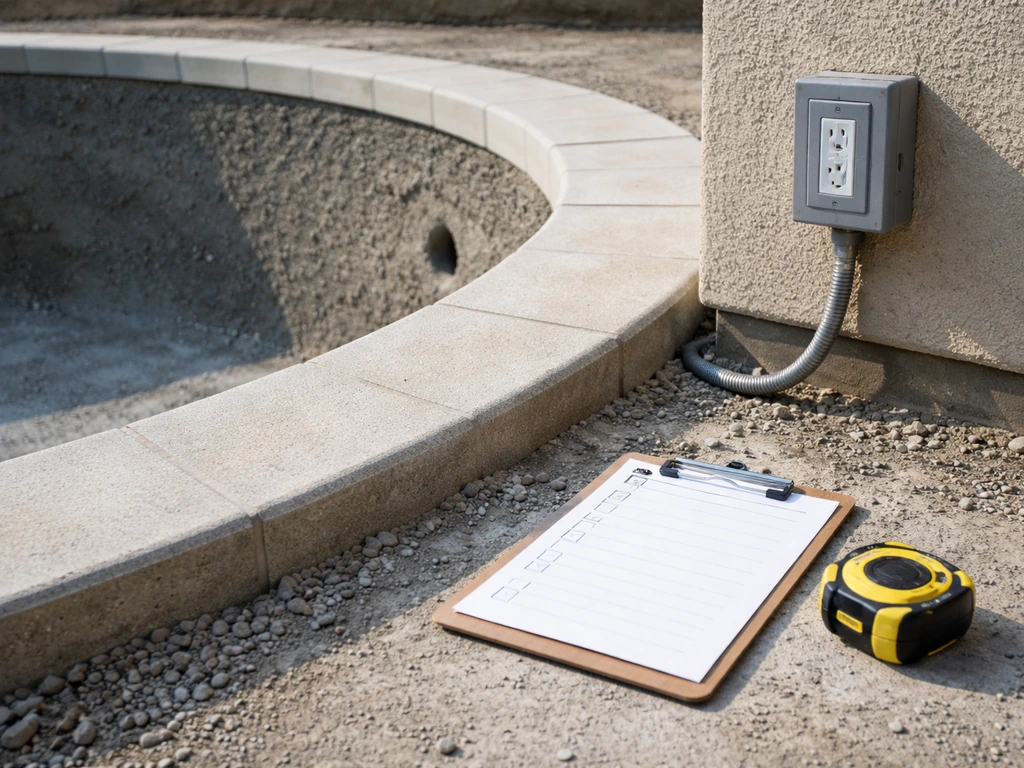
- Was electrical bonding and GFCI protection mentioned, or did the reviewer note that inspections passed? Ohio counties like Ashtabula and Clark administer pool bonding requirements locally under NEC 680.26(C), and a contractor who pulls permits and passes inspections is a green flag.
- How was equipment pad placement handled? Reviews that mention proper drainage away from the house foundation and clear access for service techs show a contractor who thinks beyond day-one aesthetics.
- Were there water feature or lighting add-ons, and did those get installed cleanly without change-order disputes?
- How did the contractor handle warranty calls or equipment issues in the first season?
For custom patio and outdoor living reviews
- Did the reviewer specify materials (concrete, pavers, composite decking, natural stone) and the project scope (enclosure, pergola, deck extension, sunroom)?
- For concrete work, did the crew allow proper curing time? Concrete is walkable around 24 to 48 hours but does not reach full design strength until about 28 days. Reviews that mention premature heavy use or early furniture placement on fresh concrete are a signal of a rushed crew.
- Were permits pulled for the deck or patio? Franklin County, for example, has specific permit applications by project type, and work done without permits can create title problems when you sell.
- Did the drainage design get called out? Patios that drain toward the house foundation show up in negative reviews as a problem homeowners discover months later.
- Was cleanup consistent throughout the project, or did the crew leave materials and debris on-site between visits?
For both project types, the reviews that carry the most weight describe the full arc of the project: how the contractor communicated during the design phase, whether the timeline held, how change orders were handled, what the cleanup was like, and how responsive the company was after completion. A contractor with 47 reviews that all follow the same vague script ('great communication, on time, highly recommend') should raise your eyebrow more than one with a handful of detailed reviews that include a few honest criticisms.
Red flags and green flags when comparing contractors

After reading a few hundred contractor reviews in this space, certain patterns become obvious. Here are the ones that matter most in Ohio specifically.
Green flags
- Reviews consistently mention the contractor pulling permits and passing inspections without prompting from the homeowner.
- Multiple reviewers describe the same project manager or crew lead by name, suggesting low turnover and an experienced team.
- Negative reviews exist but are specific, and the contractor responded professionally with a resolution rather than a defensive denial.
- Photos in reviews show finished work with clean edges, proper grading away from structures, and equipment pads that are organized and accessible.
- Reviewers across platforms consistently mention that the timeline matched the written contract, or explain clearly why it did not (weather, material delays).
- BBB accreditation is current and complaint history shows resolutions, not unresolved complaints.
Red flags
- A cluster of five-star reviews posted within a few days of each other with no project details. This pattern often signals solicited or fake reviews.
- Multiple reviewers mentioning work done without permits, or describing inspections that were skipped.
- Reviews describing change orders that appeared without prior discussion, or a final bill significantly above the written estimate.
- Any mention of electrical issues around the pool, especially if the contractor dismissed grounding or bonding concerns.
- Reviewers who say they could not get a call returned after final payment, especially for warranty issues in the first year.
- A contractor who pressures you to skip the permit process 'to save money.' In Ohio, the homeowner can be held responsible for unpermitted work.
- Reviews mentioning concrete poured in freezing temperatures or a crew that rushed a deck stain before the wood was dry. These suggest a contractor prioritizing speed over quality.
How to shortlist contractors using ratings, scope, and repeat issues
A 4.7-star average means nothing if you do not know what those reviewers actually had built. Your shortlist should be built on three filters: scope match, rating depth, and absence of repeat problems.
- Scope match first: Only consider contractors whose reviews show completed custom pools or custom patio/outdoor living projects similar in complexity to yours. A contractor with 200 reviews for above-ground pool installations and zero for gunite builds is not the right fit for a custom inground project.
- Rating depth over rating height: A contractor with a 4.4 average from 80 reviews is more reliable than a 4.9 from 11. Look for at least 20 to 30 reviews before treating the average as meaningful.
- Identify repeat issues: Read the one- and two-star reviews carefully and look for the same complaint appearing more than twice. One bad experience can be an outlier. Three reviewers all describing the same drainage problem or the same billing dispute is a pattern.
- Check recency: Reviews older than three years may reflect a company that has since changed ownership, crew, or practices. Weight the last 12 to 18 months most heavily.
- Confirm licensing at the local level: Ohio does not require a statewide contractor license for general construction, but many Ohio municipalities do. Ask directly whether the contractor holds any required local license and whether they routinely pull permits in your county.
After running those filters, aim for a shortlist of two to five contractors. Fewer than two gives you no price competition. More than five and you are spending a lot of time on estimates for work that will go to one of the top two or three anyway. If you are also exploring nearby markets, reviewing contractors in Cincinnati or evaluating other regional specialists can help you benchmark what quality and pricing look like across Ohio before you commit to a local shortlist. If you are targeting Cincinnati specifically, Cincinnati pool and patio reviews can help you compare local contractors more accurately before you commit to a shortlist.
Questions to ask and info to bring to your first estimate
Showing up to a first estimate without preparation puts the contractor in full control of the conversation. Bring a rough site sketch (even a hand-drawn one with approximate measurements), photos of your yard from the house and from the street, any HOA documents that restrict structures or water features, and a written list of must-haves versus nice-to-haves. That alone puts you ahead of most homeowners they meet.
Questions specific to custom pool bids
- Which pool type do you recommend for my soil conditions, and why? (Sandy or clay-heavy Ohio soil affects gunite vs. fiberglass recommendations.)
- Who pulls the permits, and which inspections will the project require in my county?
- How do you handle pool bonding and grounding, and will a licensed electrician be on your crew or a subcontractor?
- Where will the equipment pad be placed, and how will backwash and rainwater drain away from my foundation?
- What is the warranty on the shell, the equipment, and your workmanship specifically?
- What does your change-order process look like, and will changes be in writing before any additional work begins?
Questions specific to custom patio and outdoor living bids
- Does this project scope require a permit in my township or county, and will you pull it?
- What is your drainage plan, and where will water flow during a heavy rain?
- For concrete work: what curing timeline do you follow before placing furniture or hosting events?
- For decks: what is the ledger attachment method, and does it comply with the Residential Code of Ohio?
- If I want lighting or a water feature integrated, does that add a licensed electrical subcontractor to the project?
- What does your maintenance warranty cover, and how do I report a problem in year one?
Comparing bids apples-to-apples and what a good contract includes

The most common mistake Ohio homeowners make at this stage is comparing the bottom-line numbers without comparing what is actually included. A $48,000 pool bid and a $61,000 bid for what looks like the same project can describe completely different scopes if you do not read the line items.
When you receive estimates, build a simple side-by-side comparison that checks whether each bid includes: excavation and haul-away, permits and inspection fees, electrical (bonding, GFCI, equipment wiring), equipment pad with proper drainage, decking or coping around the pool, startup chemicals and equipment orientation, and warranty terms spelled out in writing. For patio projects, check that drainage, grading, and any structural footings are itemized separately so you can see exactly what each contractor is including.
A contract worth signing should include all of the following. If any of these are missing, ask for them in writing before you sign.
- Full project scope description with materials specified by brand and grade, not just generic labels like 'concrete' or 'paver'
- Payment schedule tied to project milestones, not arbitrary dates (never pay more than 10 to 15 percent upfront)
- A written change-order process requiring your signature before any out-of-scope work begins
- Permit responsibility clearly assigned (the contractor should pull permits, not you)
- Start date and estimated completion window, with language addressing weather delays
- Cleanup responsibilities and debris removal timeline
- Warranty terms for materials and workmanship, including how to make a claim and the response timeline
- Contractor's license number (if required locally), insurance certificate, and bond information
Even a contractor with excellent reviews is worth walking away from if they refuse to put these terms in writing. The Ohio Attorney General's office specifically advises homeowners to require written contracts for home improvement work and to ensure the contractor is responsible for obtaining permits and inspections. A contractor who resists that is telling you something important about how they operate.
Quick next steps checklist to book site visits today
You have done the reading. Here is the exact sequence to move from research to booked estimates without losing momentum.
- Pull your shortlist: Use this site plus Google and Angi to identify two to five Ohio custom pool and patio contractors with verified reviews matching your project scope. Apply the scope, depth, and recency filters described above.
- Run a quick BBB check: Search each contractor name at bbb.org. Note accreditation status, star rating, and whether any complaints are listed as unresolved.
- Search the Ohio AG complaint database: A quick search at the Ohio Attorney General's website for each contractor name can surface complaint history that does not appear on review platforms.
- Prepare your site info packet: Sketch your yard, note approximate square footage, list must-haves, and pull any HOA rules. This takes 20 minutes and signals to contractors that you are a serious buyer.
- Call or email all shortlisted contractors today: Request a site visit and estimate. Mention your project type and approximate scope in the first message so they can triage correctly.
- Confirm permit practice on the first call: Ask directly whether they pull permits for projects like yours. A hesitant or evasive answer is a filter.
- Schedule site visits within the same two-week window: Getting all estimates close together makes comparison easier and keeps you from making decisions on incomplete information.
- After estimates arrive, build your comparison sheet: Line up scope, materials, payment schedule, permit responsibility, and warranty terms side by side before looking at the total price.
- Check references for your top one or two contractors: Ask for contact info for two recent customers with similar project types and actually call them. Ask specifically about communication during the project and whether the final bill matched the estimate.
The homeowners who get the best outcomes from custom pool and patio projects are not necessarily the ones who found the cheapest bid or the highest-rated contractor. They are the ones who read reviews with specific questions in mind, showed up to estimates prepared, and insisted on written terms before work started. If you are specifically looking for Oklahoma pool and patio reviews, use the same approach to compare communication, timelines, and how issues were handled after completion. You can also look up gary's pool and patio reviews to see how those details show up across real customer accounts. That process starts today, and it takes less time than most people expect.
FAQ
If Ohio does not require a statewide home improvement license, what should I verify instead?
In Ohio, a lack of a statewide contractor license requirement means you should not treat “licensed” as the only green flag. Ask for the company’s permit history for similar pool or patio jobs (permits pulled in your county) and confirm who is responsible for inspections in the proposal, because some contractors submit permits while others only supply scope and materials.
How much weight should I put on older custom pool and patio reviews?
Do not ignore review dates. A contractor with high ratings from 3 or 4 years ago can change staffing, subs, or pricing, so prioritize the most recent 12 to 18 months and look for whether the same issues show up after that period, such as drainage problems, delayed starts, or weak cleanup.
What kinds of negative reviews matter most for pools versus patios?
Vague negative reviews can be hard to interpret, so look for review details that map to your risk areas. If your patio is on a slope, prioritize mentions of grading and drainage. If your pool includes a pad or equipment area, prioritize mentions of equipment leveling, electrical issues, and whether startup chemicals and orientation were explained properly.
What does “verified review” actually mean, and how do I use it correctly?
“Verified” badges can still be incomplete. If a platform’s verification only confirms a purchase or an account, ask the contractor for proof that the reviewer’s job matched your scope, for example photos of a similar deck elevation or the same coping type, rather than trusting the badge alone.
How can I tell the difference between a mostly positive review and a review that helps me predict my outcome?
Yes, but compare them carefully. If a review calls out a specific change order, timeline break, or warranty response, note the wording. A “great company” review that omits those specifics is still useful, but a detailed review that names the fix action after completion is usually more predictive of your experience.
What should I do if reviews complain about problems after the project is “done”?
If you see multiple reviews that mention unfinished punch lists, slow responses, or partial warranty work, you should request a written post-completion process. Ask, in writing, who performs the final walk-through, the expected punch list completion window, and how warranty service requests are scheduled.
How do I compare a cheap pool bid to a higher one when line items seem unclear?
Bring a “scope clarity” checklist when you compare bids. Require each contractor to state line items in plain language and define inclusions like haul-away type, electrical run responsibility, equipment pad drainage, and startup chemistry. If one bid bundles items together, ask for a breakdown so you can compare apples to apples.
What permit questions should I ask during estimates for pool and patio work?
Ask for a permit package summary in advance: what permits they will pull, approximate inspection milestones, and which inspections are typically required for your county. If they cannot describe the inspection steps, that is a red flag that they may be less experienced with your local process.
What should I ask about drainage and grading before signing a patio contract?
For patios, ask whether footings, structural elements, and drainage features are part of the base scope or add-ons. Specifically request that grading and drainage be itemized, including where water will flow, because “nice patio” reviews often do not describe water behavior after heavy rain.
What should a solid warranty section in the contract include?
If a contractor refuses to include the warranty details and responsibilities in the contract, walk away. Also ask whether the warranty covers labor only, materials only, or both, and confirm what counts as a service request versus a new charge if something fails due to incorrect maintenance.
How should I structure payments so I am not overpaying before the major work is done?
Expect a price range but demand payment milestones tied to real progress. As a safeguard, ask what deposit covers, when excavation and rough-in work starts, and what triggers subsequent payments, so you are not paying most of the cost before permits, electrical prep, or inspections are completed.
How can I spot fake or AI-style reviews when I am researching Ohio custom pool and patio contractors?
Do not dismiss AI-like patterns, such as repeated phrasing across many reviews or identical photo content with different wording. Use that as a reason to request more specifics, like project photos of the exact scope you are considering, and a list of recent references you can contact directly.
My HOA has restrictions, how should that show up in my contractor selection and estimates?
If you are unsure about the contractor’s experience with your exact design, ask for examples of similar work with the same key constraints. Bring your HOA restrictions (if any) and ask how they handle setbacks, material choices, and water features, because compliance problems can turn a “looks great” patio into a costly redo.
Next Articles
Oklahoma Pool and Patio Reviews: How to Choose a Contractor
Use verified Oklahoma pool and patio reviews to vet contractors, spot red flags, and choose by workmanship, communicatio
BMR Pool and Patio Reviews: How to Choose the Right Contractor
BMR pool and patio reviews guide: compare ratings, spot red flags, verify licensing, and shortlist the right contractor.
Cincinnati Pool and Patio Reviews: Shortlist the Right Contractor
Use Cincinnati pool and patio reviews to shortlist contractors, spot red flags, compare bids, and ask the right question